Dino Boukouris & Sam Bronstein: How AI, identity, and cloud security defined 2025 and what 2026 holds for founders
Download MP3Welcome to Inside the Network. I'm Sid Trivedi.
Ross Haleliuk:I am Ross Haleliuk.
Mahendra Ramsinghani:And I am Mahendra Ramsinghani. We have spent decades building, investing, and researching cybersecurity companies.
Sid Trivedi:On this podcast, we invite you to join us inside the network where we bring the best founders, operators, and investors building the future of cyber.
Ross Haleliuk:We will talk about the hard parts of the founder journey, launching companies, getting to product market fit, raising capital, and scaling to an exit.
Mahendra Ramsinghani:And, yes, we will also be talking about epic failures.
Sid Trivedi:But, Mahendra, we're here to make the founder journey easier.
Ross Haleliuk:That is correct, Sid. But we cannot make it too much easier because startups are hard, And, of course, you already knew that. Alright, YouTube. Enough. Let's get started with this week's episode.
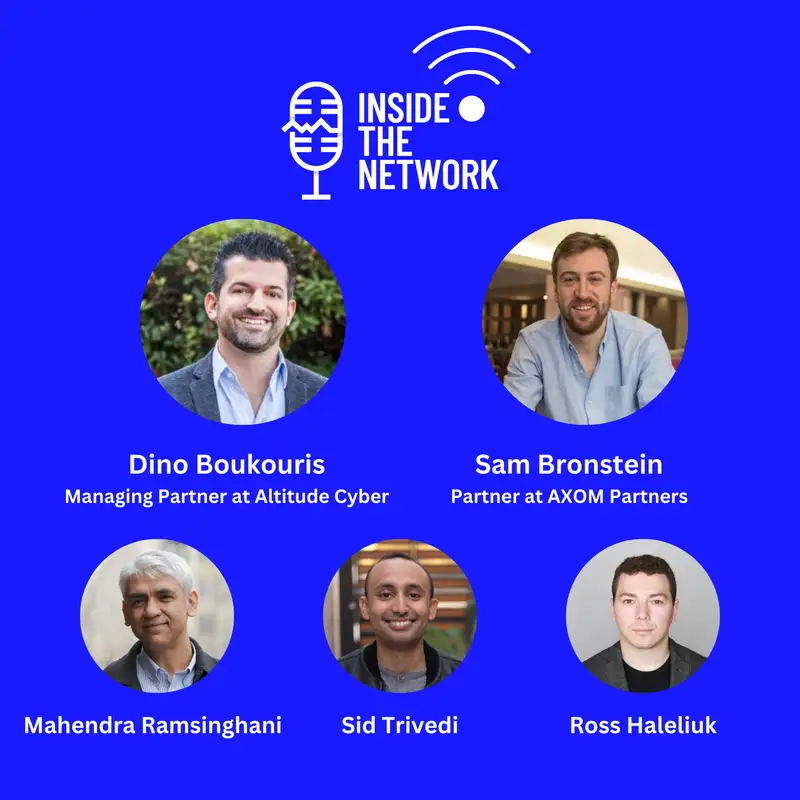
Mahendra Ramsinghani:Welcome to Inside the Network. As we wrap up 2025, we are joined by two of the sharpest minds in the cybersecurity industry, Dino Boukouris and Sam Bronstein. Now they are the silent deal makers, the CEO whisperers, consigliaries who shape some of the largest cybersecurity mergers and acquisitions. Dino Bocoris is the founder and managing partner of Altitude Cyber, an advisory firm that specializes in corporate strategy, m and a, and long term exit planning in security. Now Dino has been in this game for twenty years.
Mahendra Ramsinghani:Yes. You heard me right. Two decades and counting. And the best part is l p two cyber's monthly reports. Now these reports are considered to be the industry bible in tracking mergers, acquisitions, investments, and categories are receiving funding.
Mahendra Ramsinghani:These reports are seventy, eighty, even 100 pages long. They come out every month, and they are free. I know I've learned a lot from these reports. I'm a regular reader. And if you are a founder, entrepreneur, builder, head over to altitudecyber.com, look for the resources page, and you'll find a treasure there that could benefit you.
Mahendra Ramsinghani:Sam Bronstein is a partner at AXOM, and Sam spent nearly a decade at Catalyst. Now some of you may know that Frank Cotrone was one of the legendary investment bankers who started Catalyst Partners. At Catalyst, Sam was involved in some of the landmark transactions such as Slack's $28,000,000,000 sale to Salesforce, LinkedIn's $26,000,000,000 acquisition by Microsoft. And today at Axon Partners, he focuses on cybersecurity, AI infrastructure, and developer software. He'd already sold companies to OpenAI, NVIDIA, MongoDB.
Mahendra Ramsinghani:And so to put it differently, Sam knows how to earn the respect of these giants, how to build trust with some of the most relevant companies in our universe. So founders, as you navigate strategic outcomes in these rapidly evolving markets, Gino and Sam break down the m and a trends of 2025 and what should we expect in 2026, Be it AI security, understanding the insights of CSOs, or adding for an exit, this episode will give you some solid nuggets of how to shape your journey. Let's get started.
Sid Trivedi:Welcome, Dino and Sam, to Inside the Network. So, you know, we have a whole bunch of things to talk about as we wrap up 2025 and look at 2026. And you are two fantastic advisers to start ups and and, you know, large companies, corporates. We wanted to start with a few questions just around the buyer landscape. Looking back at 2025, what major shifts did you see in the cybersecurity customer priorities?
Sid Trivedi:It seems like cyber resilience was taking center straight sage, particularly after incidents like the Jaguar Land Rover attack, which halted production for weeks. Are boards and customers now investing very differently, and are they focusing on certain categories versus others? Dino, perhaps you could chime in to start?
Dino Boukouris:Yeah. Sure. Happy to. I mean, thanks for thanks for having us on the show. Really excited for this.
Dino Boukouris:Yeah. I mean, when you look at spending behaviors, I mean, I would say, like, you know, if you look at some of the attacks that are out there and how they translated into, you know, operational disruption, that really I mean, that's been top of mind for folks for quite some time now. I don't I don't believe there's been a kind of a a unique aspect to this that, you know, 2025, like, materially shifted behaviors. You know, I would say when you start looking at what folks are doing to augment capabilities internally, like services have always been a large part of the budget, and I think they always will be a large part of the budget. Whether that's fully outsourcing responsibilities, having some kind of a comanaged model, you know, I would expect that services are probably gonna take up half of the budgets.
Dino Boukouris:Right? Like, people and services, like, that's typically where we see, like, the majority of spend. And then, obviously, there's, you know, entire arsenal of products that folks are investing in. What I will say has, at least from our perspective, what is kind of maybe not changed, but just like the winds are shifting a bit is just there's an increased focus, and this is not gonna be a shocker to anyone on this call, but there's an increased focus to, like, what is AI doing to kind of the threat landscape? And it's kinda multifaceted.
Dino Boukouris:Right? It's, you know, how are we leveraging AI capabilities internally and what type of new attack surfaces that we just open up by doing so? Some of which I would argue are not yet understood. I mean, everyone talks about, like, vibe coding and and other methods to leverage AI to be more efficient, but I think we're barely scratching the surface of understanding, like, who do we just let into the house? Right?
Dino Boukouris:Like, what is the risk that we have now kind of entered into the equation that we have not yet kind of placed appropriate mitigations for? So I think that's one aspect. I think AI driven threats is another big one. Right? Like, how are the attackers leveraging AI?
Dino Boukouris:And, obviously, we've seen the first signs of that, like nation state backed attacks that are leveraging. I think it was, what, 90% of the attack that happened the other week, what was leveraging AI. So I do believe there's a increased spend for that second aspect for sure. I would say countering AI driven threats. I think Wizz just released a study a couple days ago that looked at, like, 300 plus CISOs and, you know, the number one area they were kind of focused on and what they wanted to spend.
Dino Boukouris:Actually, greater than cloud security, which obviously Wizz is a cloud security player, so you would assume they would have put cloud first, but they actually put these AI driven threats are what people are worried about and spending money on. And I think we're slowly getting to the point where these kind of the use of AI tools and how to protect against those. Feel like budgets are not quite there yet, and maybe, you know, a quarter of the organizations really have set aside budgets for that. Maybe it's up to 50% now. But in the next couple years, I feel like that's gonna be another huge area of spend.
Ross Haleliuk:Yeah. And you mentioned budgets, which kind of leads nicely into the next question, which is we've seen that in in 2025, nearly half of the CISOs had flat security budgets, really forcing them to do more with less and sometimes, and oftentimes forcing them to do less. In practice, did you see that leading to companies and security teams trying to consolidate their spend, to reduce costs, or did they double down on some of their best of breed tools in their environment to still make sure that they deliver a clear ROI? And, also, which of the previously nice to haves or tools that were considered nice to have became must haves despite the fact that the spending constraints have become much more clear?
Sam Bronstein:Yep. And it's great to be on here with you guys. Thanks for having me, Dino. It's great to it's great to meet you and be on with you as well. Look.
Sam Bronstein:There was definitely consolidation, but I would categorize the consolidation as more surgical, not just across the board cutting. Right? It's where can we cut commodity layers? Where are there overlapping tools? Where are there places with high licensing and operational burdens?
Sam Bronstein:Where can you realize significant cost savings from a cut? So what does that result in? Right? You know, EDR and XDR moving to Microsoft, CrowdStrike, SentinelOne, you know, SASE consolidating to Zscaler, Palo Alto, Cato, Netskope, Cisco. You know, Wizz basically took a bunch of these disparate pieces of the cloud platform and consolidated them into one solution.
Sam Bronstein:You also see a bunch of the legacy SIM and SOAR solutions being replaced by some of the AI native and autonomous options. So for those areas, there's consolidation and there's replacing. For best of breed in a few critical categories, we don't see people necessarily cutting down on spend. Right? So so where is that?
Sam Bronstein:It's it's identity threat detection and response. It's there's been such an increase in vendor sprawl and third party software usage that SSPM is super important, ransomware defense, backup and recovery, areas like that. So, yes, there is definitely a consolidation. But for a select few categories, we don't see people cutting and removing spend.
Sid Trivedi:I wanna talk a little bit about the m and a and private equity landscape. And Dino and Sam, both of you spend a lot of time looking at all of these different groups from founders to corporates to private equity firms and advising them on a whole bunch of different types of transaction. The cybersecurity m and a landscape was very lively this year. And and not to say that last year wasn't lively. I mean, we had 50,000,000,000 of deal volume last year, and this year, we've already had 75,000,000,000.
Sid Trivedi:We're already up almost 50% year over year. And this has included two blockbuster deals. We had the 32,000,000,000 acquisition of Wizz by Google and the $25,000,000,000 acquisition of CyberArk by Palo Alto Networks. How has the pace and pricing of cyber m and a evolved, and what do you see in terms of deal volume momentum and valuation trends as we head into 2026? Let's start with you, Dino.
Dino Boukouris:Yeah. Sure. Hey. Look, I mean, let's say, overall, I feel like the deal activity look at historical numbers, for example. Obviously, we had the the sugar high of 2021, right, with post COVID digital transformation acceleration.
Dino Boukouris:If if you kind of extract that and pull that out of the dataset, I feel like our activity has kind of reached a healthy steady state where it's kind of like pre COVID levels or kind of a little bit improved from the market correction, but, you know, there's no kind of, like, drastic swings that we're seeing at this point. Valuations have come back up to a healthy range. You know, deals are getting done at a healthy clip. I don't think that there's necessarily, like, buyer or seller's market per se. I think there's a lot of assets that are on the market that are kinda pushing some of the power to the buyers in my opinion.
Dino Boukouris:But overall, I'd say, you know, we're we're in a relatively healthy period. The part that is noticeable for me, it's less about necessarily, like, a multiple conversation, but the business fundamentals have shifted a bit and kind of what is considered a premium asset. And I'm sure you guys have heard this many times before, but, like, this notion of, you know, growth trumps everything has significantly changed in my opinion at this point in time. So buyers are much more disciplined, and there's outliers, and I'm not talking about, like, whiz or the moves the types of moves that Palo Alto will make that, frankly, they're not necessarily multiple type decisions. Now I'm just talking about the vast majority of m and a that's out there.
Dino Boukouris:It's really focusing on, like, the fundamentals of the business. You know? You don't have to have this, like, hyper hyper growth so long as you're not burning too much. Right? You don't have to have, like, net retention metrics that are a 150%, but you also can't have gross retention that's tracking at 70%, and you're gonna get attention from folks.
Dino Boukouris:So it's like there's different metrics, I would say, that folks are focused on at this point. But overall, I mean, if you look at private markets, public markets, like multiples for, you know, some of the higher growth companies have actually increased a bit. When you look at the spread of multiples, I think that's what's noticeably different. And I would say there's a wider range of outcomes today than there were twelve months ago. I think in the public markets, they increased by over a 100% as far as, like, what that upper peak is for the multiple.
Dino Boukouris:So, I mean, I feel like the we're we're in a very healthy environment and kind of absent any, like, massive, like, macroeconomic shocks to the system, you know, feeling pretty bullish of what 2026 looks like.
Sid Trivedi:Sam, how do you think about this? I mean, is do you agree with Dino that things are continuing to look pretty rosy? I mean, we're already seeing some of the signs of stress in the markets. And, you know, how do you think that may change how buyers behave?
Sam Bronstein:Yeah. I mean, look. Right now, I think if you if you condition 2026 as no big macroeconomic shock and no significant reversal on antitrust policy, we would expect m and a to continue to operate at high levels, record levels. You know, I think if you look at 2024, the two mega deals that got done were were super interesting because you basically had Paolo going and doing a $25,000,000,000 deal that was really a significant departure from what they've historically done on the m and a front. Right?
Sam Bronstein:They've historically bought early stage businesses, great products, great teams, sub billion dollar checks, and plug them into the Palo Alto distribution. And if CyberArk, you know, is a company that was founded in the twentieth century, and it's thousands of employees, billion plus of revenue. And, you know, what's fascinating too is it doesn't seem like Nikesh is gonna stop. Right? They just picked up Cronosphere as well and did their second largest deal.
Sam Bronstein:So he he's clearly putting his his foot on the accelerator. And I also look at that move as potentially being a bit of a starting gun in the identity wars. And and what does Zscaler do? What does a Checkpoint do? What does CrowdStrike do?
Sam Bronstein:Do they feel like they go and need to own a significant scaled asset in the identity space because now Palo Alto does? So and then if you look at Google Wiz, right, Google was on the sidelines for a long time because of the antitrust regime. And they had had discussions, you know, rumored with Wiz back in 2024, and they didn't end up consummating it likely because of their perspective on regulatory. And they came off the sidelines in a in a big way. And, you know, I remember when you talk about the cloud platforms five to ten years ago, it was like AWS clearly at the top, Azure, you know, second but not incredibly far off, and then GCP was sort of a distant third.
Sam Bronstein:And what they've done, particularly around AI with their TPUs and their Gemini models, but also with security to close the gap between where they're at and and Amazon and Microsoft has been incredibly impressive. And then, look, I agree with everything that Dino said. I think, you know, if you look at the dollar volumes adjusted for Wiz and CyberArk, it's a strong year, but it's not a record level year. And, you know, the m and a that's happened below those two, you know, we've had a very active 100,000,000 to billion dollar strategic strategic acquisition backdrop. And I don't know if I can remember so many deals in one category as we had in this security for AI category.
Sam Bronstein:Like, Palo Alto picked up Protect. Cisco did robust last year. F five did Calypso. CrowdStrike did Pangaea. F five did Licera.
Sam Bronstein:Sentinel one did Prompt. Zscaler did SPLX. So it's been super active in that category. We'll see if they still do more and more of the security for AI as architectures evolve and things change. We've seen some m and a in the AI for security.
Sam Bronstein:CrowdStrike bought Onum. SentinelOne bought Observo AI, which was a client of Axioms. And we've also seen nonsecurity buyers remain active in m and a. Mitsubishi bought Nozomi. Twilio bought Stitch, which is also a client of ours.
Sam Bronstein:Obviously, last year, Mastercard bought Recorded Future. So interesting active market expected to continue so long as there's no big macroeconomic shocks or antitrust reversals?
Ross Haleliuk:Dina, it's practically impossible to talk about the trends in the cybersecurity market unless we also discuss private equity and how that fits into the broader ecosystem. When we look at the PE, we know that companies like Tomah Bravo, for example, manage over 60,000,000,000 portfolio of cybersecurity companies, and some categories in security see that representation at a much higher level than others. In twenty ten, twenty five, how did you see the macro environment impact the PE play and the PE activity in cyber? Are we seeing private equity still aggressively pursuing take privates and roll ups, or have they become more selective in in our industry?
Dino Boukouris:It's a great question. I don't know if they've become necessarily more selective. You know, I'm not gonna name names. I just think the targets that are out there are just not as plentiful. Right?
Dino Boukouris:Because when you think about it, some of the companies that have been taken private in the past have a very different profile. It wasn't like they were just completely struggling and had no bright future ahead of them, and they just needed to be saved by private equity. Like, those aren't the types of deals that Toma chases, for example. I think it's more a function of, you know, are are there targets that remain that are not too large? Like, obviously, they're not gonna go out and buy Palo Alto, but that are attractive enough and the business fundamentals warrant their investment.
Dino Boukouris:I actually think PE is gonna turn their lens more towards, like, the the larger growth scale pre IPO type targets, and I think you're gonna see more aggressive behavior before they actually hit the public markets. And I think some of that is a function of, like, it's it's not as easy to be a public company in my opinion any longer. Like, if you look at even the last, you know, five years of activity, let's just say, four years, go let's go back to 2021. Like, you know, know before went out, They were taken private subsequently. Darktrace went out.
Dino Boukouris:Taken private. BorgRock went out. Then taken private. XeroFox went out. Taken private again.
Dino Boukouris:I know they were more SPAC. IronNet SPAC did not end well. Like, there there's I mean, though and the those companies were, the 100 to $200,000,000 type ARR range. Now for companies to get comfortable going out public in their, you know, $7,800,000,000, like, those it just kinda tipped the equation a bit as far as, like, who these big PE firms could actually go after. So long winded answer, but I would say I expect PE to stay fairly active in the space.
Dino Boukouris:I think there'll be fewer take privates just frankly because of a lack of, like, really bite sized but attractive targets in the market, and there will be more activity for these, like, growth pre IPO candidates, being, you know, gobbled up by the PE landscape.
Sam Bronstein:Yeah. I mean, I I agree with everything you just said, Dino. I mean, it's it's really interesting to think about where private equity is at today versus where they were at in the last big cyber boom. I mean, I remember when 2021, 2022, Thoma Bravo was outbidding strategics for high growth venture backed assets. And, you know, that was before 10 times revenue was a low revenue multiple.
Sam Bronstein:Right? But they were competing very actively with strategics on deals. That's not the case anymore. Right? They're they're going after businesses that are more traditionally, you know, strong ARR, strong retention rates, but, you know, profitable, lower growth, mission critical industries, likely a little older, more on premise.
Sam Bronstein:And the other private equity trend that I have been keeping my eye on, I think that there is the perspective in the zeitgeist that private equity is going to sort of be the the the cleanup crew for a lot of the venture backed companies that raised, back in Zurp. My anecdotal experience is that there is still a significant disconnect between where private equity values those companies and where both the founders and the investors value those companies. So I think we will see more private equity activity as those companies have lower cash balances. You know, their valuation expectations might compress. But, you know, with the with the scale required to go public with strategics focusing on AI and the highest growth assets, the options are limited, and I think we will see that evaluation gap compress.
Dino Boukouris:That's that's actually a really good point. Completely agree. The Zerp companies also have a second thing working against them. It's like they raised at much higher valuations, and they're slowly coming back to reality, you know, for for the founders, the investors, the folks that put money into them. But they also tended to be a different profile company where it was like, you know, high growth focusing on new customers and new ARR, maybe not the greatest gross retention metrics, maybe not the greatest kind of efficiency metrics.
Dino Boukouris:And the, you know, PEs are quicker to kind of change the criteria, and they tend to be able to change that faster than the companies can change the profile of a business because, obviously, that that takes time. So I I completely agree kind of with that, you know, notion that these ZERP companies, those that remain that were able to kinda make it until now, I I think there's gonna need to be a a bit of a reckoning between valuation expectations and kind of that just that bid ask spread has to get a little bit narrower for some of these to to see a PE as a as a truly viable kind of a home for them.
Mahendra Ramsinghani:Do you know you're using ZERP as an acronym, like a Gartner acronym for the technical founders on our audience to help them understand how zero interest rates impacted PE buying briefly. And before we move on to our next question, just double click on ZERP for a minute.
Dino Boukouris:The zero interest rate period is just, I mean, it's gonna sound quite obvious when I say it, but it basically just made access to capital very easy and made money effectively free. Right? So when money is free, people tend to spend it in ways that is not the most disciplined. And frankly, like, that environment is what led to a lot of the, you know, investments, the crazy high valuations, like these as as Sam was saying, when you looked at 10 x being a a low multiple for a company, it was it was kinda crazy, but at the same time, it's just a function of what the market demands. So that period of, you know, we called it, like, digital transformation, if you will, like post COVID interest rates dropped, and it was just like, go.
Dino Boukouris:Go. Go. Like, you can raise capital at crazy valuations. You can have of, like, eye popping kind of m and a multiples, and and it just it created this feeling of, like, you know, the the the party was never gonna end. The music was never gonna stop, and people just kept raising, raising, raising.
Dino Boukouris:You see a drastic market correction, and suddenly, you know, you're on a trajectory where you're, you know, taking off at a very high speed, and suddenly the market says that they're not gonna reward you for that high speed, and, actually, you need to be, you know, fuel efficient. So it's just it's really hard to redesign the car after you've already, you know, on the racetrack. So I think that that's kind of the dynamic that I would say for for the less, you know, financial oriented folks. It's less less about the technicalities, about the 0% interest. It's more about kind of the period of time and the behaviors that followed as a result.
Mahendra Ramsinghani:And look, guys, you know, we are almost twenty minutes into this podcast, and I'm really, really disappointed that nobody you know? I mean, Dino and Sam, you guys are smart people. My cohost may be smart, not as smart, but at least nobody has brought up the race car acquisition that had happened. You know? George Kirk's buying a Mercedes f one.
Mahendra Ramsinghani:Do you wanna touch on that before we go into some of the other fun stuff?
Sam Bronstein:If he's as good at racing or owning a race car as he is at building a company, I think he'll he'll do he'll do quite well.
Dino Boukouris:So I'm really am jealous because that just sounds amazing to actually own part of a racing team. But yeah. So hopefully, one day.
Mahendra Ramsinghani:Yeah. No. This is sort of I think my my cohost, Sid, mentioned this in one of his LinkedIn posts that there are these fascinating trends that are occurring in our in our landscape. Let's go from the private equity and the mega to what we might describe as the medians. Your Altitude Cyber reports often cover these very well.
Mahendra Ramsinghani:Talk to us about what would 2025 look like in the median acquisitions? What is top of mind in in the tech sector? You talked about AI. And how should our founders, more importantly, use that knowledge to steer their ship in the right direction in 2026?
Dino Boukouris:Yeah. It's a great question. I mean, I think Sam touched on this a bit. There's there's the number one and two and three sector that we've seen this year has been really kind of protecting the use of securing AI, whether that is looking at the protect acquisitions, looking at the Checkpoint made a bet in this play. Zscaler made a bet in this play in this space.
Dino Boukouris:Palo Alto made a bet in this space. F five made a bet in this space. I mean, you've seen most of the activity, and some people are like, oh, okay. The big bets were made. No.
Dino Boukouris:Actually, I I don't think it's over. I would expect to see a number of those players buy a second and third company in that market. There's still quite a few strategics that have yet to make their bet in that space. Some of them, you know, tried to build it themselves. Some have been going after assets.
Dino Boukouris:Obviously, I won't name names, but, you know, maybe they they came up short in terms of what they were able to bid for some of these that were taken out at really high prices. But the interesting part is, you know, if if you look at the ARR that those firms have generated, it wasn't a large amount. Right? It wasn't like they bought because the budgets were there and, you know, that they saw the the commercial traction to justify it. It really is people that are kind of gearing up, and it's an arms race for the technology and, frankly, the talent to be able to do it.
Dino Boukouris:So I do believe that the security for AI market will continue to have pretty strong tailwinds, like, through 2026. Yep. I do think there's a lot of snake oil when it comes to the the reverse of that, the kind of AI for security out there, but there are capabilities and effectively it's taking automation and efficiency to the next level. And I do believe as a founder, if you're able to successfully do that and, you know, whether you you use AIs or agents or, you know, MCPs, like, it's almost irrelevant. At this point, I think if you're able to succeed and truly drive efficient operations, I think you'll be rewarded for that in the market.
Dino Boukouris:Because we're continuing to enter in this period where it's like the attack surface continues to expand, budgets are finite. They're not infinite even if they're increasing, you know, these coming years. So I do believe that efficiency, consolidation, those those trends are never gonna disappear. And so, you know, from my perspective, like, those two key, you know, kind of factors as it relates to AI will drive a lot of the activity in the coming years. And and even if you're not in the I think it's important to note that when the acquirers are prioritizing these sectors at the top of their m and a list, you might say, oh, well, I'm a perfect strategic fit for this, you know, x y z company.
Dino Boukouris:Why aren't they buying me? Unfortunately, there's also finite resources on the acquirer side. So you might have to wait one, two, three, four quarters for them to place their bets in the most kind of highest priority markets. And as a founder, like, you need to be prepared to weather the storm. If you're not in one of the top priority areas for these acquirers, even if there is a strong strategic fit for your company, unless they see it as opportunistic, which is just a fancy way of saying they can buy you for a cheap price, unless they see it as an opportunistic kind of acquisition, you might just have to wait.
Dino Boukouris:So timing is everything, and I'd say that's the one aspect that founders don't really appreciate is it's not just about strategic fit. It's actually about timing as well.
Mahendra Ramsinghani:And, Sam, you came from a background of, you know, like Catalyst where you were, you know, involved in large transactions like Splunk. What's from your vantage point, what are some trends that you're seeing, and how should founders sort of play into that thought hoodie?
Sam Bronstein:Yeah. I mean, look. These strategic deals are really driven by personal relationships. Right? Even the deals that are the the largest in the industry, the, you know, the Splunk's and the CyberArk's, and they're a founder CEO connecting with the CEO of the acquirer, you know, maybe it's a GM of a of a business line, someone with p and l.
Sam Bronstein:And it takes it takes a long time to develop those relationships. And, you know, obviously, I'm a little biased in that my business is m and a, so I'm predisposed predisposed to encourage people to think a little bit more proactively about m and a. But when you're getting acquired by a company, you're really looking for someone on the other side of the table to pound their fist down and say, look. I'm gonna expand a lot of political capital to go and bring Mahendra over here or sit over here. And those relationships, that's not, you know, a Zoom call and a couple of texts.
Sam Bronstein:That's that's dinner. That's getting to know someone on a personal level. And once you have product market fit as a company like, I think before you have product market fit, it's premature to go and build those relationships. But once you have product market fit, unless you're just maybe you're like a whiz, and you're just like, we're we're we're only gonna show up on people's radar by just kicking ass and scaling our revenue at unprecedented rates. So maybe this advice wouldn't apply as much to a whiz.
Sam Bronstein:But, yeah, go and figure out which strategics have investment arms. Go figure out where there's an opportunity to go build a commercial partnership, to go sell together. Even if there isn't a clear opportunity to work together, but you have a warm intro with a senior executive potential acquirer, go get dinner with them. Just go get to know them. And what that will do, it will open up the chance that, you know, they wanna come and acquire you, but it will also create some optionality if someone else decides that they wanna acquire you.
Sam Bronstein:Because then when you make the call to the other buyers, you're not bringing them up to speed from day one from from a a slow start. Right? They know you well, and then you have an opportunity to get multiple people that are that are interested in acquiring you. And that's when you get some of the more interesting outcomes.
Dino Boukouris:I think I honestly I I think this point is worth reinforcing two, three, and four times. There's a mistaken belief for many founders, and frankly, like, very sophisticated boards and investors that we talk to, and and there's this belief of, oh, well, we're just not looking for an exit. And so it's like the analogy that I always use, it's like, you don't start dating when you're ready to get married. Like, you need to start the dating process well in advance. You don't know what the future is gonna hold, and leaving your exits to chance, like many boards advise, like, nope.
Dino Boukouris:We're heads down. And and to Sam's point, like, sure. If you're a whiz and you struck gold, and to be clear, striking gold doesn't equal it's in the founder's mind that I built the best technology on the planet. Frankly, no one cares. Do your business metrics, do your commercial like, does your commercial traction show that you struck gold?
Dino Boukouris:If so, you can use a different playbook. But for the rest of us mere mortals and the other 99.9% of the companies out there, if you leave your exits to chance, like, the odds are not stacked in your favor that you're gonna have a great outcome. And the value of the relationships that Sam was describing, like, I just think it's the most important thing you can do aside from building your company. Your number two priority needs to be building the relationships because you never know when you might need them. You never know, like, to Sam's point, you can actually have an LOI come in and somebody wants to buy your company.
Dino Boukouris:If it's, you know, an amazing offer, obvious decision. If it's a terrible offer, obvious decision. What if it's mediocre? And you're like, man, like, if I knew this is the only offer out there, I would take it. But if it's not, I don't wanna take it.
Dino Boukouris:And you've never built up a relationship. And that's where, you know, I won't say the b word on this call, but that's where people are like, oh, well, we're gonna call Affirm and they're gonna make a teaser for us, and they're gonna blast it out to 247 corp dev people. That's not how you're gonna get the maximum multiple. So I I think I could not agree more with what Sam was saying.
Sid Trivedi:Yeah. I I keep reminding all my CEOs that, you know, they have a couple of jobs. One, speak to investors. Two, speak to corporates and partners who may end up becoming acquirers. Three, hire the best people.
Sid Trivedi:And four, speak to customers. Mean, it's just those those four things are so, so important as a CEO. And many times, you just think that you can kind of ignore a few of those things. And and, candidly, you cannot. You have to be out there all the time.
Sid Trivedi:From, you know, the m and a markets, let's talk a little bit about the public markets and the IPO landscape. After a two year drought, the cyber IPO window finally cracked open in 2025. And, you know, we most recently saw Netskope debut on the Nasdaq at a 7,300,000,000.0 valuation, which priced above the targets, and it also popped on day one. How have the public market investors received this 2025 cybersecurity IPO in Netskope as well as the one from SailPoint? And more broadly, what do you think is gonna determine whether we see a bigger wave of cyber IPOs in 2026?
Sid Trivedi:And, Sam, let's start with you here.
Sam Bronstein:Yeah. Look. I would characterize the IPO window as opening, not wide open. Right? There have been across not just cybersecurity, but software, 11 IPOs in 2025.
Sam Bronstein:That's compared to 42 IPOs of software companies in 2021, but only a small handful from 2022 to 2024. So we're trending in the right direction. I think it's really a tale of two cities. Right? If if you look at some of the IPOs that have traded up significantly, not in cybersecurity, but in broader software, the Figma's, the circles, the core weaves, the companies that have been able to capture the imagination of both retail and institutional investors, gives them exposure to an industry that they didn't have much exposure to or maybe had limited options to invest in, like crypto or AI.
Sam Bronstein:Those are the businesses that are performing the strongest once they go public. CoreWeave and Circle still trading above their IPO price. Figma's came down, but they both had they all had big pops. The other side of the street are businesses like Navin. Great business.
Sam Bronstein:Built a builds a real scale business with strong growth over time, but didn't really capture the imagination the same way the others did. And I think that that's what we've seen a little bit in the security landscape. Right? Netskope popped nicely on the first day of trading, but now it's, you know, hovering right around the IPO price. Still trading at a nice multiple, but but they didn't have that kind of zoom up into the right trajectory after IPO.
Sam Bronstein:And SailPoint traded down a bit on the IPO and it still has gone a bit further down post IPO. And why is that the case? I think there has been in the public markets a real focus on scale. And if you look at where the majority of the price appreciation has occurred over the past two years in the public markets, over 50% of that's from the Mag seven. So there's a real view that you have to be doing something super unique and special to get us to rotate out of NVIDIA, Microsoft, Google, and into into your company.
Sam Bronstein:And with Netskope, right, they are obviously a pure play Sassy vendor, the only one that's on the market. But investors might look and they say, okay. Well, I could also buy Zscaler or Palo Alto. They're, you know, significantly less risky in all likelihood, and I still get exposure to that same product and category that I want. So, look, I I I think the IPO window is opening, and it's good to see companies go public.
Sam Bronstein:But I think it is challenging to go public if you aren't one of those super shiny objects. And I think you get into a situation where it might be preferable to get to get acquired. And and that doesn't even that doesn't even start to factor in the cost of going public and how expensive it is to to do an IPO. You know, 7% of proceeds, 10 to 20,000,000 of fees. It's very, very expensive.
Sam Bronstein:So, yes, IPO window is cracking open, but not wide open.
Ross Haleliuk:And talking about the shiny objects and talking about the fact that some companies that very few companies are on track or would have been on track to go public, we have to talk about Viz. Right? Like, earlier this year, Viz surprised the market by deciding to to get acquired by Google for 32,000,000,000 instead of going public. Obviously, many in the industry assumed that Viz's successful IPO would open the room and and become that first big success that would then demonstrate an opportunity for other companies to follow. And yet given the outcome and given the fact that the sale has raised questions about the IPO pipeline, what does a mega deal like this say about late stage cybersecurity firm's preferences and their decision to choose the m and a over IPO?
Ross Haleliuk:And do you think that there will be more cyber unicorns that will decide to take a similar path instead of facing the public markets? Dino, I think this one will be will be to you.
Dino Boukouris:So couple thoughts here. We're talking four years ago or three years ago. You know, you you go public, you can have, you know, call it 175, hundred fifty, February, 250,000,000 of ARR. Those types of targets were truly having a decision of, you know, do we IPO or do we consider some kind of m and a outcome? When you get to the scale of your revenue, kind of you're you're you're measuring it with a b.
Dino Boukouris:Right? And you're saying, okay. Well, you know, we're gonna hit a billion of revenue this year. As much as you'd like to think there is, like, there's not that many buyers that are out there for companies that reach that scale. So most of the time, it's not it's not really in your control.
Dino Boukouris:Right? If you don't take the off ramp when you're bite sized and you actually have a pretty wide pool of buyers, like, you're left with, like, a handful of folks as a security company that you might get snapped up by. So I don't think, like, as you scale, it's like your options dwindle when it comes to m and a. So that that's the first, I think, challenge when it comes in obviously, of us can read the minds of Wiz, but I think that's one of the challenges is Wiz was growing so fast. Like, their their pool of buyers was getting smaller and smaller, you know, by the quarter, not by the year.
Dino Boukouris:Second thing is people don't often appreciate an IPO isn't an exit. Right? Like, an IPO is just the next chapter. Like, it's next kind of challenge and the next, you know, part of your journey. Getting acquired for 32,000,000,000, that is an exit.
Dino Boukouris:Everybody is getting cashed out. Investors are making money. The founders are making money. Employees are making money. That is truly an exit.
Dino Boukouris:So it wasn't like, you know, what exit do you want? It was either exit at a very healthy price or keep going and, you know, see how big you can go. Go compete with Palo Alto. Go compete with all the big players that are out there and see what the public markets do. And then over time, yes, you can sell shares and you can find liquidity for your investment, but it's kind of a misconceived notion where an IPO is necessarily an exit.
Dino Boukouris:Last last comment I'll made on the list is, I mean, they raised that what it was like a 12,000,000,000 valuation in May 2024. So to look at selling at three times effectively, almost three times that valuation less than a year later, it's really hard. Like, if you're valued at 12,000,000, being valued at 36,000,000 a year later, yeah, no big deal. It's really hard to turn $12,000,000,000 into 32,000,000,000 in a year. Like, when you get to that scale of numbers, being able to triple that type of an investment and, you know, call it, like, less than twelve months, that's not easy to do.
Dino Boukouris:It's really hard to say no to that type of a return.
Sam Bronstein:Yeah. And the other dynamic in the IPO markets that are interesting, if you look at the top echelon of of companies and I I think right now, the companies in cybersecurity are maybe a little bit too early to be considering going public, like the Sierra and the islands, the sort of shiniest objects. But if you just zoom out to broader technology, Databricks, Stripe, SpaceX, right, They're just sitting there, and they're like, how would we ever go public? You know? We get we have a good secondary market.
Sam Bronstein:We get our employees liquidity that way. We don't have to pay a bunch of money to go public. We don't have to get asked questions on a quarterly basis. So you've really had the illiquidity discount for these companies turn into sort of an access premium because people wanna get their money into those companies, but they can't. So it's sort of a fascinating inversion of what we used to traditionally think of these late stage private companies and what they wanted to do.
Mahendra Ramsinghani:No. I think both of you make excellent points here, Dino and Sam. You know, IPO being the next stage of the journey. You know, one of the thoughts that comes to mind is our guest, Tomer, from SentinelOne. If you look at the company I mean, here's a company that has crossed a billion dollars in revenues.
Mahendra Ramsinghani:It's I didn't look at the markets today, today, but but it's probably sub 10,000,000,000 in terms of market cap. And when you look at that as an example of how the public markets operate versus a $32,000,000,000 outcome to a company like Google, I mean, clearly, you know, the halo of an IPO is not necessarily as attractive anymore. Right? I mean, here, Stromer is still working his ass off, and our friend that we have, you know, gonna move on to the next journey. So it's a very interesting dynamic in the IPO market.
Mahendra Ramsinghani:I mean, talk to us about what are some things that you're seeing in the public markets, a shift to, like, growth with profitability. Growth was valued. Now growth with profitability becomes important. What What are some other metrics that you're seeing at the public market level that are becoming more important?
Sam Bronstein:I can take that. Look. It's it's no longer an optional thing to be profitable. Right? You know, interest rates have reset the valuation frameworks.
Sam Bronstein:Market learned a bunch of painful lessons from the IPOs of 2020 to 2021. So it's no longer optionable to be profitable. So, look, market's punishing high burn, low gross margin, inefficient go to market, growth that's super dependent on sales and marketing spend. When you think about the metrics that are required to trade well in the in the public markets, right, you think about rule of 40. Should be at least 40%, ideally, 50% plus.
Sam Bronstein:Free cash flow margins, at least breakeven, ideally 10% plus. Gross gross margin, 75% and above, ideally in the eighties. NRR of 115%, if not higher. Gross retention of 90%, if not higher. So the bar and this is all for companies that are at significant scale.
Sam Bronstein:So, right, when you're a $200,000,000 revenue company, it's generally easier to grow at a a high rate. When you're a $600,000,000 revenue company, to sustain a 20% growth rate or above is is very challenging. So it's a tough time to be a public company. It's a tough time to try to be going public because the market has become significantly more punishing of companies than it has been in the past.
Dino Boukouris:Yeah. And to to translate what Sam's saying, you know, kind of down into the private markets, because I do think I think it's a fair question for both public and private companies. You know, as as Sam mentioned, right, like, the growth that you're talking about, people talk about, like, rule 40 and growth at the public levels. If you're able to sustain 50% growth at the public levels I I I hear founders do this all the time. They're like, well, what do you mean I can't trade like Zscaler?
Dino Boukouris:Like, they only have, like, x percent growth. I have the same amount. It's like, yeah. But they're doing it on a base that's, you know, a 100 x bigger than you. Right?
Dino Boukouris:So when you think about growth, like, at private markets, like, you should be well north of 50% growth, ideally well north of a 100 if you wanna be considered kind of best in class. I think gross margins are the one thing that translates nicely. Getting north of 75, 80%, and I realize there's times where you're just not optimizing for margin when you're at the earlier stages, and I get that. But if you don't have a clear path to get into those healthy margin territory, you'll get penalized even as a private company. And then maybe rule of 40 is a little less relevant for the earlier companies, like some type of some people talk about rule of x where you kinda weight the growth stronger than profitability, but there are other metrics that you can use.
Dino Boukouris:Right? You can look at, like, burn multiples to see how much you're burning relative to how much you're growing. You can look at magic numbers to see how efficient your sales and marketing organization are. I mean, I know kind of we used to always talk about kind of LTV to customer acquisition cost ratio. So there's there's, like, efficiency metrics in your business that you you can you can and should be measuring, monitoring, and improving as a private company.
Dino Boukouris:And then there's the other ones that are kind of true for public and private. And and I think retention is probably the biggest point that I wanna emphasize. Gross retention has somehow become the new king and not retention. Now retention's important, and you absolutely need to have it. But if you have a weak gross retention number, even if you have best in class net retention rates, you're gonna struggle to attract attention because people are fundamentally wondering, like, okay.
Dino Boukouris:Like, you know, you have some customers that love it, but you have true product market fit, or you maybe not dialed in to your the right ICP. And, I mean, there's some PE firms that if you're not north of 90%, like, no. Thank you. Like, it doesn't matter what the rest of your metrics are. Like, 90 is a hard line now.
Dino Boukouris:And I would say five years ago, we were actually not seeing that. So there there are some metrics that I would keep in mind beyond growth that matter for the private markets as well.
Mahendra Ramsinghani:Yes or no, Dino. Is the market ready for outcome based pricing? You know, if you look at the AI world, it's gone into the whole outcome based pricing. It's moving there fast. Is cybersecurity market ready for outcome based pricing?
Dino Boukouris:Not for product. I don't think that's the case. For services, perhaps, but the product companies will probably argue that there's too much that comes down to how you implement the solution, how you manage it, how you integrate it. Like, I I don't see product companies, in my opinion, signing up to that anytime soon or at least most of them. You know, you do see things where product companies, when properly installed, will give some kind of, you know, a guarantee of their service or, you know, they're backed by a cyber insurance provider that'll underwrite some kind of a guarantee.
Dino Boukouris:I I've seen that before, but I would say service companies, people are probably gonna push more towards outcome based service. But, again, there's just there's so many variables where it's really hard to guarantee an outcome these days. So I I know that's not a yes or no answer, but I think for product, my answer is no.
Mahendra Ramsinghani:Sam, yes or no?
Sam Bronstein:Yeah. I don't think that they're ready for that. I think what Dino said is right. And, look, you know, the whole technology world is experimenting with the right way to price and deliver AI services. They're trying to figure out what the terminal state gross margin for these businesses is.
Sam Bronstein:So it's just a rapid it's a period of significant change. And, you know, it feels like we're in the primordial soup phase of AI as people figure out the right way to go to market, deliver the services, price them. So it's quite fascinating.
Ross Haleliuk:As we approach the last part of the episode, we would like to talk about the advice for founders. You know, 2026 is coming very, very soon. The market is changing. The market is evolving. Both of you guys have a fantastic view and a fantastic vantage point to see where things are headed.
Ross Haleliuk:Sam, let's start with you. As we turn the page to 2026, which emergent problem areas or gaps in cybersecurity do you believe are especially ripe for new startups and startup founders to tackle?
Sam Bronstein:Yeah. Look. I'll break it into two two zones. Right? The first zone is AI, and the second zone is non AI.
Sam Bronstein:So within AI, there's a bunch of, interesting new companies that have been funded around using agents to pen test. Still early there. Still think the customer traction is limited, but lot of really strong teams raising capital. Agentic security. Right?
Sam Bronstein:Is that sort of tier is that phase two of where security for AI goes? If the first wave was security posture management for models, is that now evolving to SPM for agents. How does the SIEM evolve? Right? How does the SOC evolve?
Sam Bronstein:What what do tools look like in in in 2028, not just 2026? As far as more broadly speaking, look, I think identity is is potentially the next battleground in security. Right? Every company now has EDR on their endpoint, CSPM for cloud, SASE, regular pen tests. It's become significantly harder to breach the network in the traditional ways.
Sam Bronstein:And a lot of the a lot of the things that people were bullish on in identity haven't really panned out. Like, MFA hasn't been the silver bullet. LLMs have made phishing attacks a lot easier. The third party and contractor access has has exploded, so the software supply chain is significantly more more at risk. And I think that's why you see Palo Alto going and buying CyberArk to to unify networking, cloud, data, identity.
Sam Bronstein:And I expect that to be an area where the other players in security make moves. I look at what the private equity firms own. You know, what does TOMA do with Ping? What does Francisco do with BeyondTrust? What does TPG do with Delinia?
Sam Bronstein:And then, you know, what happens to agentic identity and auth? Is that an independent is that a large enough category to create a a massive independent player, or does it get rolled up into a broader platform? So, I have my eyes very closely on the identity segment over the next year or two.
Dino Boukouris:Yeah. And I I think that last point, I I I think is worth rekind of emphasizing. Like, we are living in a world where organizations are writing code they don't really understand to take actions they didn't anticipate with resources they're not monitoring, leveraging identities and permissions they don't actually manage and monitor on a regular basis. Like, the and I'm not saying identity is a silver bullet for that, but truly understanding what does it take to understand identities, permissions, like, all of the aspects that, you know, it it was challenging enough with humans happening at kind of machine scale and with AI kind of, you know, pulling the the strings and the and being the puppeteer of all things. I just I don't think we are prepared for the challenge ahead.
Dino Boukouris:So I do believe there's gonna be an opportunity for startups and companies that will help us solve that problem because it's like we are running way faster than, you know, the security tools can catch up at this point in time.
Mahendra Ramsinghani:You know, I would highly recommend our audience to also listen to, you know, or read this report by Anthropic, which talks about the first AI orchestrated cyber espionage. It just came out. It's a 14 page report about how cloud code was used to build a campaign. 17 organizations were successfully infiltrated in a record time. So, you know, we live in very interesting times.
Mahendra Ramsinghani:Now if I'm a founder trying to raise capital or if I'm a founder trying to exit, you know, here I'm looking at 2026. I'm listening to all the data and statistics that you're sharing. What are two or three things I should keep in mind as I plan my next step, you know, raising capital or exiting? You know, what would you advise me?
Dino Boukouris:Yeah. I mean, look. I can I can give my thoughts, and and sounds like Sam and I will be pretty aligned on this? I mean, we already talked about business fundamentals, so I don't wanna kinda belabor the point. But do not underestimate the value of strong fundamentals.
Dino Boukouris:Like, the days of just selling a great idea on a napkin, unless you've built and sold, you know, six companies yourself, do not underestimate the the notion that you need to focus on your business fundamentals, operational metrics, etcetera. Two, the relationship point that we were previously making. Do not underestimate kind of how early you need to start building relationships. And I don't mean you should be thinking about, oh, I'm gonna sell my company. No.
Dino Boukouris:Absolutely not. But you should be building relationships across the industry, like the GMs, the strategy folks, product folks. Sure. Corp dev people talk to them too. You know, it's good to have those relationships because you just can never predict when you're gonna need to leverage them.
Dino Boukouris:And I think the last point I would make for founders is, you know, this obviously, most of you who are are investors yourselves, but they really need to think carefully each time they raise capital. Right? Like, it's not just about valuation. It's not just about key terms. But, like, you need to think about composition of your board.
Dino Boukouris:Like, what are the investment objectives of the investors that you're bringing to the table? Are you bringing investors that have these massive funds that are swinging for the fences and won't even be interested in, you know, some offer of you know, you get a $2,300,000,000 offer where you as a founder, as a first time founder, never exited before. You're like, this is amazing. And your investors are like, that's a rounding error for us. Like, you know, we we don't wanna take this.
Dino Boukouris:We wanna we wanna go for the whiz or bust. Right? So think about who you're actually bringing around the table. Because just because you can raise some, you know, massive round of capital at a crazy valuation from a massive fund doesn't mean you should. Like, you need to align with what your goals and objectives are for the company, what the rest of your investors' goals and objectives are for the company, and you need to just kind of look at that holistically.
Sam Bronstein:Yeah. Look. I I agree with with everything that Dino said. Right? Once you raise a round of capital, you've reset your shot clock.
Sam Bronstein:You've reset what success means, and you should think about it very, very carefully. The I guess the one thing that I would add, I think that first time founders particularly underthink marketing a little bit and doing their best to show up in these Gartner Magic Quadrants and sponsor conferences. And we've seen companies in security with great example, Thyera, great example. Island, great example. And they've really captured the attention of people around one specific market.
Sam Bronstein:And that requires not just great product, not just great distribution, but making sure that you're branding and marketing your product and company effectively and actively.
Sid Trivedi:Well, this marks our twentieth episode of Inside the Network. It's pretty amazing that for you know, after all those hours and hours of recording, Mahendra, Ross, and I are still still doing these episodes. So I'm I'm glad that we've stuck together. And, you know, Dino and Sam, you've both been fans of this show from the early days. So thank you so much for, you know, believing in us, tuning in, and then agreeing to to join us for this, you know, end of 2025 episode.
Sid Trivedi:And with that, as we kind of wrap 2025, most of the folks who are listening to this, hopefully, they'll be on a beach somewhere or maybe they'll be taking a walk in some, you know, nice forest landscape or or, unfortunately, they'll be sitting at their desk thinking about 2026 and all the things they need to achieve in the new year. But, hopefully, they'll have a little bit of time on their hands to listen to this episode, but perhaps some of the others. And with that in mind, I'd love to go around the room, and I'll ask my cohost to also chime in here and just share one interesting thing you learned from listening to any of the past few episodes. So just one thing. And, Sam, let's start with you.
Sam Bronstein:Yeah. I I thought the the interview you guys did with Shlomo was was super interesting. I love the story about him on the patio trying to figure out he kinda had realized that his original idea for Kato wasn't gonna work. Right? He was just putting it in the data center, looking at East West traffic.
Sam Bronstein:He ended up pivoting to a much larger vision that really became sassy. And I thought it was a great lesson in just going back to first principles. If you realize something doesn't work, just scrap it and start from the beginning. And, obviously, that's gone. That has gone pretty well for him.
Sid Trivedi:Dino?
Dino Boukouris:Yeah. Look, I mean, it's recent episode. Obviously, you guys had Tomer, CEO and founder of SentinelOne on. I mean, I I think it it might sound simple, but, like, the points are so spot on.
Dino Boukouris:Like, you really need to focus on having truly differentiated product that is solving a major need for folks and not just slapping, like, AI powered everywhere and thinking that that's gonna cut it. You need to find, like, a sustainable product market fit. I mean, sometimes people think, oh, you hit a few million of ARR, and you're all set. Like, let's call it a win. Like, no.
Dino Boukouris:That is that is nowhere near the point where you can be confident we have product market fit, especially if, you know, some of the metrics we talked about earlier. Right? Like, retention metrics and others are not that great. So I think from from a from a lessons perspective, I really just like the simplicity of what he was focusing on. But I will say a a second learning for me as far as, you know, the the episodes you guys have had, you know, between the three of you, the real thing I learned is you guys are some of the best connected individuals in cyber based on the caliber of people you brought up on the show, well, until today at least.
Dino Boukouris:So even being mentioned in the same sentence as some of the legends you've brought on, like, that's that's the real honor for me. So I I really appreciate it.
Sid Trivedi:Ross?
Ross Haleliuk:For me, I think it was the episode with Jay, the founder of Zscaler. And the story that I found absolutely fascinating is that, that, look. If you're building something disruptive, customers oftentimes are not going to get it. And, obviously, it is not always easy to tell if you're just being wrong or if you're just being dumb or or if you are truly onto something big. But I did find it rather fascinating that when when Jay was talking to security leaders at the time when he started Zscaler, nine out of 10 people were looking at him saying, like, look.
Ross Haleliuk:What the hell is this? Like, who cares? Like, this is not a real thing. And I think it almost goes contrary to this advice these days and the way the founders approach picking the problem area or picking, you know, the the problem to solve where everybody goes to interview sisters to ask them what's important to you. And what Jay did is is he did all of that, and he's seen nine out of 10 people saying, you know what?
Ross Haleliuk:We don't care about this. But he flipped it and said, you know what? That means that 1010% are saying yes. And he went on, and he and he built a company which ended up becoming one of the most successful companies in our industry. So to me, it's stories like that are truly different and that are rather fascinating.
Sid Trivedi:Mahendra?
Mahendra Ramsinghani:No, Sid. Actually, I want you to go. In fact, I want your our audience to know that, you know, three of us do these things behind the scenes, but, really, Sid works the hardest amongst all three, you know. I mean, Ross, you know, he's got a big smile. He shows up.
Mahendra Ramsinghani:I I get dragged into these. Like, I'm like, guys, you know, you don't need a dinosaur at the table. You know, I'm like Charlie Munger now. I don't have anything to add. But these guys will, like, call me, text me, and here I am.
Mahendra Ramsinghani:So no, Sid. You should go first. You know, I'll I'll go last.
Sid Trivedi:You know, I I think the interesting thing for me, there are lots of amazing ones, but Joe Levy, the CEO of Sophos, he made this comment that fewer in one in 10,000 businesses today have access to a CCEL. I mean, that's truly amazing when you think think about it. Fewer than one in 10,000 businesses. And he he described this. He had his team pull this up for a internal kind of off-site where he said, they've pulled it up and there are 360 businesses globally and only 32,000 CISOs.
Sid Trivedi:So it's just a reminder of just, you know, how much how hard it is to kind of, you know, have the level of talent that we that we need to go and be successful enough and have, you know, high quality, you know, cybersecurity capability. And it's a good reminder for, you know, all the founders who are trying to go and build amazing businesses that at the end of the day, we're trying to protect not just the 10,000 businesses that have access to a CISO, but the 360,000,000 other companies that need to, you know, protect against digital risk. Mahendra.
Mahendra Ramsinghani:Sid, you make a very good point. I think the real all of us are here together and why we've done 20 episodes and, you know, better part of the past decade is our we look at our role as a small way to try and protect the society and help the good guys win. And when I think about all the episodes we've done, gee, the tough part was trying to pick one because I can think of the two Doug's, you know, Doug Merritt and Doug Song as some of the top episodes or top kind of insights that we gathered. Clearly, Doug Merritt, building Splunk, and more importantly, building culture. You know, he is sort of really at the top there in terms of how he engages with everyone, how he cares about people, and how his people love him.
Mahendra Ramsinghani:I mean, he's clearly one of the rare leaders in cybersecurity. And then Doug Song, you know, he came from this absolutely gritty background. I mean, if you hear that episode, it still gives me the chills. Like, growing up in Jersey right next to this casino, you know, I'm sure there are war stories that he has not even shared about. And then he builds this company, which is filled with outsiders.
Mahendra Ramsinghani:Like, he did not hire people from inside the cybersecurity domain as such and has one of the epic exits, most capital efficient company built in our business. So the two does stand out. And my favorite was the fun episode the three of us did live at RSA with with Andy Cowell. You know, that was so much fun. So yeah.
Sid Trivedi:Well, with that, thank you everybody for tuning in for 2025, and thank you, Dino and Sam, for ending out with a fantastic overview.
Dino Boukouris:Thank you, guys. Appreciate it.
Sam Bronstein:Thank you so much for having us.
Sid Trivedi:Thank you for joining us Inside the Network.
Ross Haleliuk:If you like this episode, please leave us a review and share it with others.
Mahendra Ramsinghani:If you really, really liked it and you have some feedback for us, wrap it on a bottle of Yamazaki and send it to me first.
Sid Trivedi:No. Don't do that. Mahendra gets too many gifts already. Please reach out by email or LinkedIn.