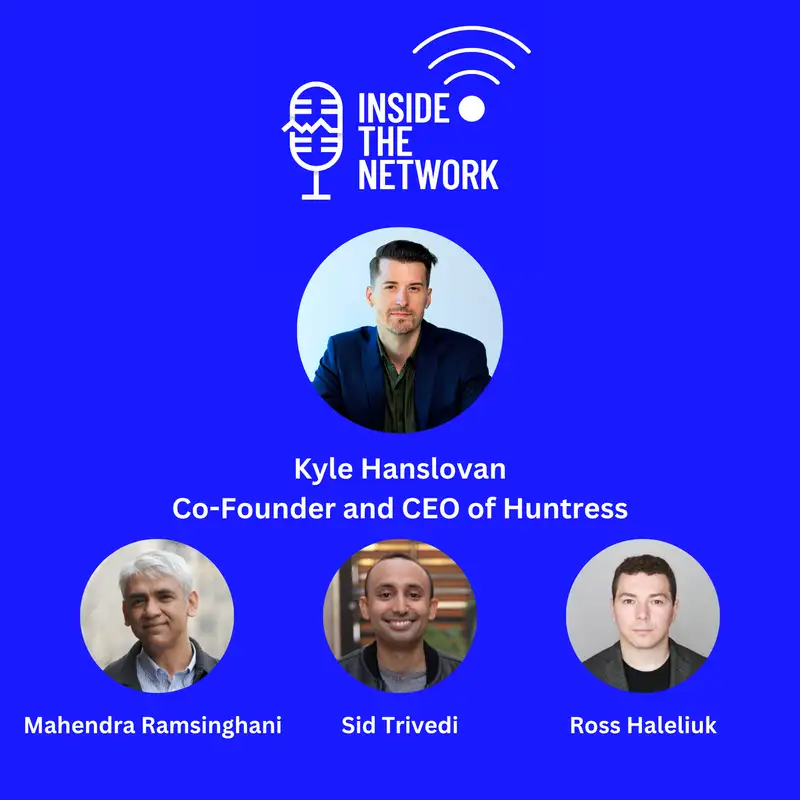
Kyle Hanslovan: Building Huntress into a $3B+ unicorn by securing the 99%
Download MP3Welcome to Inside the Network. I'm Sid Trivedi.
Ross Haleliuk:I am Ross Haleliuk.
Mahendra Ramsinghani:And I am Mahendra Ramsinghani. We have spent decades building, investing, and researching cybersecurity companies.
Sid Trivedi:On this podcast, we invite you to join us Inside the Network where we bring the best founders, operators, and investors building the future of cyber.
Ross Haleliuk:We will talk about the hard parts of the founder journey, launching companies, getting to product market fit, raising capital, and scaling to an exit.
Mahendra Ramsinghani:And, yes, we will also be talking about epic failures.
Sid Trivedi:But, Mahendra, we're here to make the founder journey easier.
Mahendra Ramsinghani:That is correct, Sid. But we cannot make it too much easier because startups are hard, and of course, you already knew that.
Ross Haleliuk:Alright, You two. Enough. Let's get started with this week's episode.
Mahendra Ramsinghani:Our guest today is Kyle Hanslovan, cofounder and CEO of Huntress Labs. Kyle grew up, in his own words, as pretty darn broke. No money for games meant hacking the DRM to play them.
Mahendra Ramsinghani:No money for Internet meant cracking AOL, the Internet service provider, to stay on it. That scrappiness was part necessity, became an obsession, and sent him into the US Air Force at 17, where he spent years running classified offensive cyber operations at the NSA, fondly known as no such agency. When he left the NSA, he saw something most of the industry was ignoring. The hackers were not. Hackers weren't just going after governments and Fortune 500 companies.
Mahendra Ramsinghani:They were going after the small businesses, the law firms, the dental offices, the mom and pop shops, businesses like his mother's salon, the ones with no security teams, no fancy budgets, and no one looking out for that. So Kyle and his cofounders built Huntress. VC said no 30 times. The market is too small. The deal sizes are too small.
Mahendra Ramsinghani:The churn is too high. But Kyle and his cofounders kept going anyway. Customers were paying, and that was all the proof they needed. Ten years later, Huntress is approaching $500,000,000 in revenues. It has 250,000 customers, a unicorn valuation.
Mahendra Ramsinghani:And the best part, the team has not moved upmarket once. The average contract values are still $20,000. How did Kyle, a pretty darn broke kid, pull this off? Welcome to Inside the Network.
Sid Trivedi:Hey, Kyle. Welcome to Inside the Network.
Kyle Hanslovan:What's going on, Sid?
Sid Trivedi:Well, we're gonna talk about a whole bunch of different things, and we'll get to Huntress. But before we do that, we wanted to chat about your early life and your military service. Let's start right from the beginning. You grew up, in your own words, pretty darn broke. And we've heard stories that you would pirate your own first video games.
Sid Trivedi:You were hacking into AOL chat rooms. Tell us a little bit about this early life.
Kyle Hanslovan:Alright. So you've clearly done some of your work. I appreciate that as, you know, a fellow Intel guy. Yeah. I did.
Kyle Hanslovan:Pretty darn broke is probably the literal exact words I used. And with that, you know, you don't have access to as many things. So you could imagine abusing those free I think they were AOL floppies in the early days. There wasn't a ton of validation of who you actually were till they caught on later. I think by the time AOL rolled the free CDs where your time on the Internet was measured in minutes to get really creative.
Kyle Hanslovan:And so to be very frank, my earliest days and my only access to video games was could I pull apart a video game? Could I figure out how it's DRM, you know, the the digital rights management software work? And how could I generate a valid CD key that would allow me to play these offline games? So there's a lot of reverse engineering that kinda quickly teed me up on that, like, hard pivot into, you know, real offensive cyber when I joined the service at 17. So I actually give a lot of credit to, like, adversity kind of motivated a lot of my skills.
Kyle Hanslovan:Thankfully, they were never anything too shady and really teed me up to get into that reverse engineering malware thinking like an ethical hacker.
Sid Trivedi:Did you catch up with and did you meet any interesting folks during those early days? I mean, we've heard about several hacking groups that have been pretty important later on in life. Doug Song in the past has talked a little bit about some of the things he did and the folks he met as a result.
Kyle Hanslovan:So what's funny is Doug and I, he's probably one of my closest early stage mentors I could get, Doug Song and Jono over at Duo. And so we didn't meet on bulletin boards, but when you're cut from that same fabric when you later meet in life, it's crazy how unifying it is. So yeah, the early days of like, I really missed kind of came in at the tail end of bulletin board systems. My whole life was on IRC. And part of being IRC, this is where the hacker handles and the cool names came from.
Kyle Hanslovan:I was never that cool. I always just went by Kyle or some silly handle like that. But between that and learning how to like, if you remember back in the day, you know, you were on less than 56 k. So even things like writing my own software to download large movies and to download large video games and resume that type of software, like that whole environment of meeting other people too that were like, oh, you're running into this. Here's how you can adjust this, or here's how to write your own software kind of fueled a whole, like, group of founders that later stage in my career helped mentor me to leaving the service.
Kyle Hanslovan:So I can't say that, like, anyone was like, oh, man. I was part of this really cool hacking group that we did things. But I will say that whole community of, like, problem solving absolutely, like, changed my career.
Ross Haleliuk:Kyle, you served in the US Air Force doing offensive cyber operations work, work that is by the very definition described and classified as mission driven with the kind of resources and the kind of access that most of the people in the private sector will never see. But at the same time, unlike in countries like Israel, service members in The US don't often take that leap to go and and build their own business, at the very least, not to build a venture backed company in cybersecurity space. Plus, I don't think DC at the time was known as the very big and established entrepreneurial hub either. What was it that gave you that belief and conviction that you can and should start a company?
Kyle Hanslovan:That's that's that's actually a really good observation because you're right. Most of the friends that I know who really crush it in that world tend to pivot more to like defense contracting. And it's not that defense contracting, you know, you can make good money there, but that that you are right.
Kyle Hanslovan:There is something different. I think that one of the biggest differences between kind of, like, you know, TAO, CNO, US, you know, intelligence services versus, like, 8,200 style Israeli services, there's a little bit of a culture difference of, like, showmanship too. And to be very frank, that was something that I always enjoyed. Like, I used to be a technical trainer.
Kyle Hanslovan:So even, like, I wasn't very good at speaking in the earlier days of Huntress, but I was good at technical education, speaking at Black Hat, b sides, training at DEFCON, stuff along those lines. So I think for me, because I had that edge and I spent time with other people who had both technical chops and some of that prowess, some of that showmanship, you're right. I guess I did. I broke that kind of a little bit of that mold. And although there's others, like Ron Gula was both Air Force and NSA, and he did Tenable.
Kyle Hanslovan:So it's not unique, but you are right. There is something there. I'm not a 100% sure if any one single moment for me I think my biggest one was that mission commitment. I had such a crazy obsession with since my mom had helped us grow out of poverty and she had a small business of her own, I just couldn't shake this idea that, like, my mom would never be able to afford my talent. And so while I actually think the service gave me a lot of my technical skills, working at, you know, no such agency where PR was always a thing we frowned on, It was you know, no comment was the standard thing we did.
Kyle Hanslovan:I probably had to have that external pull, and it was this idea of a bigger mission, not just national security, but like, what about everybody else that falls below the Fortune five hundred and how can I do that? And I think that's what pushed me out because I did you know, I dabbled in defense contracting for about a year, but we pivoted from Huntress immediately into, you know, pure commercial product instead of government services.
Mahendra Ramsinghani:Kyle, your sense of mission is clearly one of the things that is a common thread in some of our guests here. Even Rob Lee talks about the importance of protecting critical infrastructure, and that has been his mission from day one. Two questions that come up. One is, tell us a little bit about more about how your mom's entrepreneurial journey and what business was she in. And then the second question is, how your shift occurred around the qualities that the no such agency gave you that applied to the start of both?
Kyle Hanslovan:No. That's cool. I I actually I don't think anybody's ever asked me this question, so this would be cool to kinda get out there. So my mom was really big at like, just because you have a skill doesn't have to define you. And like for instance, she was an accountant, and she was an accountant at university systems, so very low level.
Kyle Hanslovan:But what she learned is through an accountant, what makes businesses work, what makes businesses not work. And she actually took the opportunity when we later moved to Florida that she could create a salon. She saw demand, but she knew and had heard of a lot of salons, for instance, delivered value, but they weren't necessarily the best operationally run. And so for her, she didn't practice hair or nails or tanning or any of the other spa services that were there. She was purely an accountant, but she saw kind of a need.
Kyle Hanslovan:And I as a 14, 15 year old boy, just like hanging out my mom's salon for all the perks that came with. We're talking about haircut services and stuff like that. Right, guys? No. But I'm somewhat serious here of my mom saw an opportunity that her skills could provide rigor to an industry that didn't necessarily have the right rigor.
Kyle Hanslovan:And that actually broke us out of like, you know, I won't call it like poverty, but we'll talk about free lunch and usually hand me down used clothes into what I would call a real middle class life. You know, this salon ended up blowing up to like 5,000 square feet after I joined the service. So she really found a niche. And I don't think I considered that at this time. Like as I'm like later in life and I'm now doing like therapy to help understand why I am the way I am as I'm trying to like figure out how to keep sprinting a marathon without burning out.
Kyle Hanslovan:And so as I think about NSA, that whole time and commitment to just finding an opportunity to be something part of bigger, I think I missed a little bit of that. I was in junior ROTC as a kid. I really like community service. And so that was part of the bigger reason for me to join the service, but it was also opportunity. And so when I had the opportunity to go from a basic communications expert into, like, true offensive cybersecurity, I jumped all over that.
Kyle Hanslovan:And NSA's mission was like a dopamine hit. You know? When you have access to all of the data. And I think people underestimate to just how large all of the data could be. It gave me experience into like data science.
Kyle Hanslovan:A lot of good data science is actually classifying and categorizing data. And that starts with what data to throw away. And I think all of those became like really interesting attributes of like when you work as a small compartmented team and you have ungodly amounts of data, you have to use crazy amounts of automation to be able to sift through it. Like it's too much that any one human in the loop is too slow. It's you know, you you need humans, but they need to be more in the lead.
Kyle Hanslovan:And when you did your job right in the counterterrorism world, you know, people went home safely. And when you messed up, it wasn't like my mom's salon where if you mess up on somebody's hair, they have a bad hair day, but hair grows back. You have sometimes like loss of life. And I think those as I'm thinking about that transition from a punk 17 year old kid to a young thirties, more grown up kid, young man. I I don't think I fully started maturing till that.
Kyle Hanslovan:I think all those played into that decision that I was like, you know what? Come twenty fifteen, I'm not gonna do the full twenty years of retirement. I'm gonna go and use these skills and try to do what my mom did is take a group of skills that were unique and service a market in a way that just hadn't been serviced before.
Sid Trivedi:Let's talk a little bit about Huntress. You you kind of mentioned some of the areas and and the things that got you excited. You cofounded Huntress with Chris and John, two people that you'd worked alongside in the Intel community. Tell us about the founding dynamics back then between the three of you. What sparked the origin story for, you know, going and building this company, and then how did you just divide responsibilities?
Sid Trivedi:And I think that the amazing thing for the founders and operators listening in today is that the three of you have worked together for a decade on this company through all the ups and downs, and we'll talk a little bit about that. But it's pretty amazing that that you've stayed, you know, kind of intact and as as a founding unit.
Kyle Hanslovan:Yeah. Are you guys cool with me telling maybe more of the, like, the private side of the story? Please.
Kyle Hanslovan:Like, you know, you can always pitch, like, the what went extremely well.
Kyle Hanslovan:Like, knowing and dating somebody before you marry them, that's an obvious decision. We know that's important. But, like, founder life, I don't know how certain founders just decide I'm gonna work with that person, like, and, you know, mesh up together. You know, John, Chris, and there was actually a fourth founder in the very, very beginning named Mark.
Kyle Hanslovan:We had all worked in the intelligence world. We had been through very high highs. We'd also shared a number of really low lows. Both some of it was, like, post Edward Snowden. There were some things we were disappointed about.
Kyle Hanslovan:Like, The US didn't do the greatest job telling that story honestly. They allowed when you don't establish a narrative, one will be filled in for you. And so there was a lot of disenfranchisement we had at this time that we wanted to kind of like you know, we needed to change things up anyways. And what's funny is Chris Bisnet, my CTO, and he's the guy that in a world full of 10 x engineers, Chris will say hold my beer and show you what a 100 x engineer looks like. He didn't wanna get on board.
Kyle Hanslovan:He was actually the last one. And he said like, you guys are crazy. If this problem was this easy like, we were doing offense. We were seeing people actually like when people don't think about this. When you're gathering intelligence, sometimes other hackers or other nation states share the same infrastructure with you.
Kyle Hanslovan:Meaning, you're on the same victim and they don't necessarily know if you're there and you don't necessarily know if they know you're there. It's a really interesting situation. And so we had really good evidence that we were like, those are terrible criminals or those are terrible nation states. We really could catch them a lot better. But Chris wasn't on board.
Kyle Hanslovan:And even though like him and I had been teaching fuzzing for vulnerabilities, a zero day finding class at Black Hat for years at this point. We had a real deep relationship. But being able to fight both at work and fighting that in, I think it's very similar to folks. I respect people who choose not to move in with each other until they marry them. But to be very frank, I think it's much better to get that conflict out of the way.
Kyle Hanslovan:What's really interesting is we went and we founded Huntress with four of us, but one of the founders actually did not want to fully pivot. He couldn't leave defense contracting. So to Ross's question earlier, this was a guy that he just it wasn't his fit. And to be very frank, you know, it kinda was one of those situations where, like, this isn't working. You need to go back to what's working.
Kyle Hanslovan:And, like, firing a founder or moving away from a founder isn't easy, but like we would have ruined things. If we would have ruined our cap table, there would have been more dysfunction. So like knowing how to handle conflict is like, I would argue even more important in the earlier stages than getting along. You you both are important, but the reason I'm sharing it this way is, you know, it wasn't until somebody else like, instance, my very first $50,000 check, that's what it took for my cofounder Chris, who is the other board member, other common board member with me. John, my my third cofounder, he's the only smart one.
Kyle Hanslovan:He he hired his own boss, like, three years into it and has been able to live, like, a deeply technical life that's happy in the company. He's still with us. But the point that I'm getting is the guy that's still on the executive team, still making a huge difference on the board, practically didn't wanna join Huntress because he thought the problem wasn't actually different. And it took somebody else writing a $50,000 check, and he's like, okay. Maybe I'm missing something, and he corrected.
Kyle Hanslovan:So just hope that helps founders who are thinking about their own dynamic that externally we sell a very unified story that everything was always perfect. But I just said in the same pitch, one founder had to more or less leave, and one founder almost wasn't a founder until somebody else wrote the first check. And then he's been a huge part of our, like, growth and innovation story. So I hope that helps motivate people that most of the time, it's it's not as pretty as the press releases sound.
Sid Trivedi:It's an amazing story. And I'm curious, did you know the responsibilities between the different founders? Like, was it obvious that you were CEO? Was it obvious that Chris wanted to be CTO? Were those things obvious, or was that something you needed to debate and decide on?
Kyle Hanslovan:You were cracking me. I'm literally writing a CEO inflection document right now. I just opened this document. I started this about three months ago and I'm almost done. I I do these memos about every three years that give direction.
Kyle Hanslovan:I'm gonna go in here and this is titled what gives me energy. And so I'm reading verbatim right now. It says, in the earliest days of Huntress, founders had to choose titles. Neither John, Mark, or I debated Chris was the obvious choice for delivering scalable innovation as our CTO. Mark enjoyed running operations, so naturally he landed a COO title.
Kyle Hanslovan:Considering John's quiet demeanor, I needless to say had to land the CEO position while he led threat operations. Oddly enough, we never revisited this. I have no clue how I fell into the CEO position. Like that is as real as it gets. Like I never chose to be CEO and in hindsight, I wish I would have known it's like the loneliest job on the planet.
Kyle Hanslovan:So like John, you know, he he just he's he's like the smartest guy in the room who doesn't say a lot of words. So, like, that's not gonna work in the CEO role. So if you can't tell, like, I'm currently working through this ten years later of, like, why didn't we reassess? And the reason for this is like, I'm not going anywhere as the CEO. I'm now realizing after ten years of doing this, I need to be adapting to my biggest strengths and what puts wind in my sails, which means I'm always complimenting myself with a different style of executive.
Kyle Hanslovan:We don't have a COO today, but as I'm preparing for the future of about $500,000,000 in revenue, I will probably make that COO hiring right before we cross that next year. So it's just a really interesting scenario of, like, no. We we that's how we did it. John, you don't speak, so you're the threaded operations guy. Mark wants to be COO.
Kyle Hanslovan:Chris, you're the obvious CTO. I guess I'm CEO, and that's that's no joke. That was
Ross Haleliuk:Super cool. Kyle, let's let's talk a bit about the the focus of the company. So the vast majority of the cybersecurity startups start by targeting the enterprise buyer. You, on the other hand, were very intentional and focused Huntress on the SMB and the mid market customer, building, and bringing the enterprise grade cybersecurity capabilities for everyone and not just the 1%. Looking at your success today, many people would assume that it was obvious that the SMBs will need somebody to to take care of them, where SMBs will need somebody to fully focus on them.
Ross Haleliuk:But I am sure it wasn't at all obvious to you. It wasn't at all or maybe it was obvious to you, but it wasn't at all obvious to the industry. It wasn't at all obvious to the investors at the time when you started. Yeah. And I would assume that many people bet against you.
Ross Haleliuk:What did it take to prove them wrong?
Kyle Hanslovan:So I have always anchored to, like, when you know a truth, not when you believe a truth, but when you have, like, empirical evidence, that can take you through a lot of things. Even you know, because that's ultimately what it takes to be able to prove somebody wrong is you believe or ideally know something, something is a fact, and you can push through it. So my ultimate benefit is I had been watching hacking changing for years. Right? I joined the service in 2003.
Kyle Hanslovan:So hacking had changed a lot since 2003 till even 2013. And so I had started to see the early phases, even in nation state hacking, becoming more commercialized. And at the very end of my NSA time, I was actually a contractor, meaning I had left government service. I'd still wore what we call a green badge, and I had been a contractor. So I watched my own role as a government, you know, call it offensive operations expert, move to the commercial world.
Kyle Hanslovan:And it was so clear and obvious to me that this hacking business was going to move from just steal the things that matter from a nation state perspective, secrets perspective, into steal the things you can make money. So I believed in the capitalism. I had seen that firsthand. I had also seen so many really sloppy groups. Sometimes cyber criminals would just stumble on.
Kyle Hanslovan:Sometimes they would be script kiddies and they had no idea the computer they landed on has like world powers also sitting on it. So like I had that confidence that and most people just didn't realize that a lot of these nation states sometimes start with very small enterprises and swim their way upwards. Because coming in the front gates is sometimes very well fortified. And so I didn't care that the investors didn't believe me. I did care though if customers wouldn't give me a dollar, right?
Kyle Hanslovan:Because none of the stuff, I could have the greatest software in the world. I could do all the things that I promise, but if people aren't willing to separate a dollar from their pocket, like that would kill my business. And so I just focused there. I said, all right, the market's not here yet. There wasn't a quadrant, investors aren't here, but I'm solving something that somebody's willing to pay me for in a recurring revenue model over and over.
Kyle Hanslovan:And so I ultimately just kept growing revenue. I was like, you know what? I wanted to pour more fuel onto the fire to grow revenue faster. But part of what got me through that and allowed me to just hear so many of the no's over and over and over was like, well, I'm making money and I'm bootstrapping. And so we did go slow.
Kyle Hanslovan:The first three years of Huntress were really bootstrapped. But I think that's a really key point. If you are not growing revenue, but you still have this crazy conviction, you have to ask yourself how long are you gonna put yourself through the grueling punishment. But since I was making money and it was a flywheel, I could go pour this much gas, get this many leads that could convert to this many trials, that could convert to this much revenue, and I could do that like a flywheel. I was like, well, I'll just prove them wrong, and I outlasted them, Ross.
Kyle Hanslovan:So I I don't know. I don't I think it's because I had so much proof. And I think I just realized like there was nothing that would stop me as a cybercriminal from like pillaging my mom's business that I was like, okay. This is gonna catch on. And thankfully, being a first mover that way was hard.
Kyle Hanslovan:But boy, once people started catching on and once automation picked up and now all of sudden it went from attacks are targeted to now your targets of opportunity because anyone can now be hacked. Dang, it was a good place to be in because I got to ride that momentum. So I hope that's me saying, and like, I don't envy people who have to come and help make a market because it's a really bad idea. But if people are willing to pay you money for it, especially predictable amounts of money and aren't churning, like what better indicator do you need? They're spending dollars.
Ross Haleliuk:I remember talking with Rick Gordon who used to run Mach thirty seven, and he told me that he was always absolutely sure that you guys will succeed. I'm curious, what do you think you did differently early on in those early days when I'm sure it was just a lot of messy trying to figure things out? What did you do at the time that allowed you to win later on?
Kyle Hanslovan:It was that obsession on the dollar. I think a lot of it. There was also a lot of, like, you got to be relentless. But because I had worked so much in the government, I'm going speak on behalf of my co founder, John. When you work in a compartmented facility and you can't have a phone, you can't have a smartwatch, you can't really be on the internet, that's not the greatest of happy working conditions.
Kyle Hanslovan:So we had a really big motivation not to go back into the SCIF, right, not to go back to the government. So for John, he was like, I don't like to take a whole lot of risk in my life, but if I don't have to work in the SCIF, I guess I'll take more risks. So the point that I guess I'm going through is Rick had seen, one, we didn't want to go back. Two, we had deep domain knowledge. I actually think people underestimate how important domain knowledge is.
Kyle Hanslovan:And our domain knowledge could be applied to a model where people wanted to pay. They weren't willing to pay a lot. Definitely not like enterprise. There are no even today at Huntress, our average deal size is like $20,000 annually. So there's very few million dollar deals in the Huntress book of revenue.
Kyle Hanslovan:But I showed a model of failing that like if I could get to a low touch high velocity and Rick was all about that. Rick was like, wait guys, if you could figure out a channel that you're not knocking door to door on small businesses, but a one to many model with this technology, he just believed from the beginning that if you could do that, you could create the largest cybersecurity business in the world. Not because we were so great, but everybody underestimates how large the world is below the even global 2,000. It's ungodly large. And so for Rick, I think he just had faith in those three things.
Kyle Hanslovan:One, we didn't want to go back to the government. Two, we had deep domain expertise and were willing to pivot. And three, as long as you could figure out the cost of acquisition to lifetime value and be able to acquire customers fast enough and small enough to be able to build predictable revenue, you were probably gonna win. So he is right. I mean, and Rick Rick was the guy who wrote that $50,000 check that convinced my cofounder Chris to come on board, by the way.
Mahendra Ramsinghani:So just to build up on that, Kyle, you know, as you look at the SMB market, some of the obvious questions that have been prevailing in the industry is there's a lot of churn. 20 k ACV is not attractive enough. How do you go one to many? Can you just expand on how you were describing that dynamic? And what do Huntress do specifically when it comes to go to market?
Kyle Hanslovan:Yeah. The the one thing, the service, this is this is a real head nod to the military side, is you learn a lot of discipline. And I was not a very disciplined teen, so I kind of needed that. But when you go to the SMB, you need to know very clearly who you are and who you are not. And so for instance, one of the things that the SMB tends to work on are these things that are like pay as you go.
Kyle Hanslovan:So think about non contracted revenue. Hey, however much you consume, I'm gonna charge you that much, but no commitment on a month to month and no committed minimum. And I will tell you that one of the first things I started learning about why so many businesses kind of from small enterprise all the way down to small business were failing is businesses sometimes aren't very disciplined. But if you went to go look at like Verizon who is selling cell phone service to small business, those businesses were actually thriving. And if you remember the earliest models of cell phone service to business, they would tell them, each person, you have this number of minutes.
Kyle Hanslovan:You can pool all the minutes together, but if you go over those number of minutes, I'm charging you per minute. And for instance, while I will let you have a month by month contract, I'm going to charge you substantially higher for that. Or if we can commit to each other a predictable revenue stream where you just commit to me twelve months, I will only charge you the flat given rate and any overages we agree. It turns out there's a lot of really savvy business owners that are like, I'd rather take the much cheaper fee. And so as much as I wanna say it's because I was the super hacker, I convinced all these businesses, they knew hackers were on their door.
Kyle Hanslovan:I just built a really respectful business model that said, you have a pain point. You have a very limited budget. I'm going to add a lot of pressure to you if you want this month by month, no contracted, unlimited overage world. But if you're willing to commit to me for twelve months, and you're willing to commit that anything you do has to be this minimum, even if you drop below this minimum, one, that makes Huntress an actual pretty healthy business. But two, it weeds out the people who are the most likely to go out of business.
Kyle Hanslovan:It weeds out the people who are most likely to be late and have quality of earnings. It also weeds out a lot of the people that are just going to like in the SMB, one of the biggest reasons for churn that not many people talk about is actually consolidation and acquisitions. And so by me having this really strong upfront contracted revenue model, I didn't even know it at the time, but I was weeding out like the vast majority of the businesses that weren't going to be in business twelve months later anyway. So like, I wish I could take credit for this. This was just part of having discipline.
Kyle Hanslovan:But now that I can look in hindsight, some of the biggest decisions I chose early on was it's actually really important who you say no to in the SMB because they're probably not gonna be around in twelve months anyways.
Mahendra Ramsinghani:Oh, it's a it's a very fascinating insight. I think one of the first times we're sort of listening to this kind of perspective when it comes to SMB. Now if we wear our investor hat, Kyle, SMB is not sexy to any of the VCs. You got a lot of rejections. I mean, talk to us about the raising your first round, all the challenges you went through, the times you got rejected.
Mahendra Ramsinghani:And most importantly, how did you keep yourself going?
Kyle Hanslovan:So I did a lot wrong, but for the right reasons. What I mean by this is when you come from a world where if I overinflated what I could do at NSA, national security could be at risk and in counterterrorism mission, it was the most palatable. It's why I use this example. Like if I said, oh, we could protect these people and save these people and no, there's not going to be a bomb and all of a sudden people blow up. You can imagine there is almost like a world that I came from that would punish you if you overstated what you could do.
Kyle Hanslovan:I did not realize for a very long time that everybody takes what a founder says and automatically discounts this anyways because founders are like, they're able to see something that they nobody else can see, but they also have to right size it that this probably isn't gonna go the way that the founder says. And here I am giving like the most accurate myopic pitch. Like I was not telling a big vision. I wasn't telling what it could be. I was only telling it what I could guarantee.
Kyle Hanslovan:And it turns out not many people got excited about that. I had also not figured out my whole business model when I first started getting my rejections. Like for instance, I went to a lot of direct small businesses and I had not figured out the ultimate thing that not only would help minimize my churn, but also accelerate my growth was partnership. For businesses that were under 250 employees, I didn't figure out that partners were my one to many solution. That came much later.
Kyle Hanslovan:And so for VC, I pitched a lot of time people who had never done a channel first go to market model. And so in many times, a lot of my rejections were my fault for not pitching aggressively enough. I obviously didn't know. I wasn't being more lofty, more visionary. Thankfully, some really good VC beat my ass privately on like on this side.
Kyle Hanslovan:They really, they they were not, They didn't say nice words, but they said it in a nice way of how bad my pitch was. One time was over tacos, and I'm saying this because like, if it wasn't for that feedback loop, I would have just kept going with the bad pitch for as long. Like, I didn't know. I didn't have the feedback telling me. And the reason I'm saying this is once I had both learned the partnership model, and then I realized that some VC, even with a better pitch, were never gonna get on board because they didn't like SMB and they didn't understand partnerships.
Kyle Hanslovan:That's actually how I found Forgepoint. Forgepoint had just invested successfully in AlienVault. AlienVault had didn't partner with MSPs, but further upmarket with the MSSPs who are also like the outside outsource security help. And so as soon as I started finding VC who I had a better pitch, I could tell them more lofty. I could share what I wanted to do.
Kyle Hanslovan:At this point, AlienVault, I think, was just acquired by AT and T. The team at Forgepoint is like, I've seen an exit. I know this could work. And so they were actually the right partner. So if you can't tell, it wasn't just VC being mean to me.
Kyle Hanslovan:It was me not being very realistic on you have to find the right partner. And that for me actually, I turned down later stage because I had got to the point where I was now in 5,000,000 of recurring revenue. It was retaining 90 plus percent of the time. And I was landing, adopting, expanding, meaning my net dollar retention was actually growing faster than any normal industry averages. I got good term sheets, but I still went with Forgepoint who necessarily wasn't the sexiest per se, but they were by far the best partner.
Kyle Hanslovan:And they we we crushed it together. So, you know, I I guess that's my long way of saying I'm thankful that we were able to keep the company afloat because I did have good finances and good financial fundamentals. But much of my failure and what kept me going was I knew again I was making the right money. I just had to find the right partner. And that came.
Kyle Hanslovan:Series a didn't come for a long time, five years after we started, but it eventually came.
Sid Trivedi:Well, we're in 2026, and we're thirty minutes into this conversation. We haven't yet mentioned AI. So let's get into at least that topic that feels like an important conversation to talk about. Obviously, the AI mark you know, wave has completely changed every submarket, including cybersecurity and the threat landscape more broadly. We're certainly seeing the creation of very highly capable models from Methos to GPT 5.5 to whatever Google launches at IO given its IO day today.
Sid Trivedi:Yep. How has Huntress started to evolve to both take advantage of this new AI tooling, but also manage the heightened risk that it creates?
Kyle Hanslovan:Yeah. So I'm gonna start first with, like I think it's very important to, like, define what AI means to a company. And so for me, we never used the term internally AI. It was always like, it's data science, it's automation, it's workflows. And so pre let's call it pre 2022, the level at Huntress was for every one single human in the lead of our automation, we could manage 140,000 endpoints.
Kyle Hanslovan:So we already had extreme automation. And this goes all the way back to I actually think I gave an homage to it earlier. At NSA, you have so much data that if you're not automating your way out of it, it's impossible. So small human teams leading ungodly amounts of automation, data science workflows, and then being able to deliver an actual valuable outcome. So I had already leaned in pretty heavy to the, I guess you would call that like pre agentic side of automation.
Kyle Hanslovan:But LLMs, right, where I was using some of my AI at the time more like machine learning, I wasn't using it for the nondeterministic problems like QA and feedback loops. And so in 2022, we started looking at AI and going, we're not sure if these LLMs are ever gonna get to the point where they can do detection engineering for me. But we started tinkering more and more with like I'd call us AI pessimist in '22 to '23. By '24, we had done enough tinkering that we all said and had become, I would call it, like, AI curious. Right?
Kyle Hanslovan:We were not fully in AI. And to be very frank, we just continued saying, let's automate workflows as best as possible. I would really say more of the company's DNA was if AI was a solution for better automation, so be it. But we are not we would never call ourselves an AI native company. We're a diehard research lab that creates an ungodly amount of automation, but we were not an AI native company.
Kyle Hanslovan:But that kind of changed in, I would say, the investments we made in very late twenty four set '25 up where we were like, listen, these models still have a lot of issues. They are still very nondeterministic. But you could start building scaffolding around these systems that maybe have not given you the most predictable outcome. And the first place we actually started is we started moving into what we now call an AI centric company. That's just being realistic that AI native has a place, but every company I know that is started AI native is now bringing a very thin layer of humans into the loop to lead that automation.
Kyle Hanslovan:That's why I use that word AI centric. And so for me, I started looking at this as a multiproduct solution. I started realizing I had all these individual products that were plumbed together on the same platform, but it was very rigid. If this condition happens let's make it more relatable to the audience. If an end user runs a piece of software that gets their credential stolen, automatically make an integration into Google Workspace or Microsoft three sixty five, nullify that credential, reset it, and simultaneously queue them up the appropriate awareness training to help mitigate this from happening in the future.
Kyle Hanslovan:That's very rigid. And so the change we started making in that twenty five time period, we started realizing, wait, AI is nondeterministic. And so it might be able to help with some of the waiting and some of the routing decisions. And we had pretty okay success with that. We also had pretty good failure.
Kyle Hanslovan:Fast forward to '26 though, the models have gotten, I would call it notably better. And places where Huntress used to say AI will never play a role in detection engineering. We really thought it was too unpredictable. You could run the same malware sample 10 times, or more importantly, 10,000 times through a model. And having a 70% consistency rate means 30% of your base is really angry at you.
Kyle Hanslovan:So we couldn't trust a lot of that technology. But what we ended up learning was as the models got to a more accurate situation, and we started running a lot of AI, kind of like now how people do coding where they'll say, hey, Claude, build me a plan. Here, let's start with the test cases. Now build me software to achieve this plan. And it will kick off a workflow that says Claude builds.
Kyle Hanslovan:It runs through a CICD pipeline. The software passes or fails. If it fails, it goes back to Claude. Claude inspects the failure. It rewrites the code, and it goes in that circ that that process till you get a predictable outcome.
Kyle Hanslovan:We've learned that instead of just making Ironman suits that make our humans better, we could actually build systems engineering just like that code example around detection engineering. Human or some indicator found something malicious. Let's throw it to Claude or whatever your AI du jour is. Build a system that says, okay, I think this is how we're gonna detect it. Run it against today's data, yesterday's data, the last week of data, the last month of data.
Kyle Hanslovan:Oops, it can false positives, Rejigger the detection engineering. And we're actually very close to the point right now where I would call us definitely not fully autonomous, but much closer to a high autonomy capability that certain of our detectors don't need a human in the loop and are more like Terminators than iron men and or iron man suits. So I hope that guys gives you guys a like, we have really failed our way through AI. Like, we are not in a grand solution where it's all of a sudden like we just knew AI was gonna change the world. And we've been very selective on find the right problems and the right systems engineering to use AI correctly, which means sometimes you want to embrace nondeterministic outcomes.
Kyle Hanslovan:Like I mentioned, the decision making between many products. And sometimes you can build scaffolding around nondeterministic workflows in AI and actually get a very predictable, solid quality result that doesn't need humans. So, guys, I hope that you can go anywhere we want on this question, but I'm an open book here. If it's not clear, Huntress did not start AI native, and to be very frank, we still got a lot to learn because we also bring debt. A second mover advantage, though, also happens, which allows me to I've got a lot of the human workflows there.
Kyle Hanslovan:Now how do I marry those together? So
Ross Haleliuk:Kyle, the Huntress website has, I think, around 17 battle cards laid out against multiple categories, EDR, SIEM, awareness training, and and many more. You can well, I I could see Huntress against CrowdStrike versus SentinelOne, Proofpoint, Sophos. That sounds like a lot of competition. Which of all of your competitors keep you up at night?
Kyle Hanslovan:Yeah. So, when I'm internally presenting at the company, we live on a world where Microsoft and CrowdStrike own the Fortune 500. We don't actually try to wedge ourselves in there. Sometimes CrowdStrike moves down from Fortune 500, and they've had some success moving to the Global 2,000. But we really look at those teams even though we don't go head to head in sales against both those teams.
Kyle Hanslovan:They have the researcher DNA. They have that offensive commitment to mission. They have the ability to keep up. And so even though I don't go toe to toe against CrowdStrike very often, we look at them as that is real competition because they come from the same DNA that we have. They'll be able to elevate their technology to whatever new innovation comes.
Kyle Hanslovan:Today's AI, maybe tomorrow will be AGI that we're now having to adopt and leverage, right? Or quantum. Both of our teams have to be able to stay at that razor's edge of performance. And so that's who I actually internally, we as a company look at both of those companies. That doesn't mean there's not tons of people that are protecting customers that we believe we could do a better job at.
Kyle Hanslovan:Like, for instance, there's a whole legacy world of, like, I still don't fully understand. If you look at who's leading the edge of research, I'm not big on, like, talking trash about certain companies, but there's a reason so many companies are starting to get acquired or struggling to maintain growth. Let's just talk about this and so I don't be trashy. Like, CrowdStrike is growing 30% year over year on 5,500,000,000 in revenue. Why are some companies struggling to grow more than 30% revenue on a billion or a sub billion.
Kyle Hanslovan:That means there's something wrong there. That also means that some of it is just as Microsoft and CrowdStrike have dominated the Fortune 500 and trying to come down, And Huntress really figured out the sub 250 employee company and below, and Huntress has rapidly moved up. I think it's gonna be very hard to exist between Microsoft CrowdStrike and Huntress. It's again two purpose built vehicles. CrowdStrike and Microsoft have kind of hit their own where they won't be able to successfully come down.
Kyle Hanslovan:Huntress coming up, and this brings room for new disruptors. I mean, Ross folks that are creating awesome new AI native technology, we actually hope to see more of that competition because there's a lot of legacy, maybe ones that I don't feel com or that I do feel comfortable maybe throwing some shade. Like, how is McAfee and Symantec still relevant in 2026? Like, that that that's a very legacy business model. And because of their sales motions, they have some deep access.
Kyle Hanslovan:But we're talking they're sitting on hundreds of millions of revenue and protecting businesses that if you look, the researcher DNA isn't the same thing that you would see at a CrowdStrike, at a Microsoft, at a Huntress. So for me, competitors, it doesn't surprise. I didn't know we had 17 battle cards, But I have a feeling those are very targeted at either one of two things. Keeping those enterprise players up in there where they belong in the Fortune 500, while simultaneously kind of making our very aggressive move on anybody who's below the Fortune 500. So that'd be my guess of what the team strategy is.
Kyle Hanslovan:But if you can't tell, I actually think DNA is the biggest indicator of who's actually competition. I don't look at most of those companies that I have battle cards as actual competition. They're kind of in the way right now.
Mahendra Ramsinghani:Speaking of researcher DNA, Kyle, you know, this is something very unique to the cybersecurity sector, generally speaking. You know? Rarely do you see these kinds of researcher DNAs being exhibited front and center in other verticals. Imagine you're talking to Wall Street. Imagine you're talking to a group of business executives who don't understand the nuances or the importance of publishing the kind of work you do.
Mahendra Ramsinghani:On one side, it sounds like intellectual showmanship or braggartatio, like, look how smart we are. But there is really a kernel of importance in what you're describing. Tell us more about it. And secondly, how does AI change all that?
Kyle Hanslovan:So, Mahendra, you you're actually nailing it. I I I don't know why this topic like, think about real industry champions. Like, think of a Frank Slootman, somebody who not only won once at, you know, ServiceNow, turned around and won again at Snowflake. Right? I am not so sure in the post AI era, the Frank Slootmans will be able to keep up with top quartile and top decile innovation anymore.
Kyle Hanslovan:So Wall Street definitely hasn't. I I was just last night, I was at JPMorgan's Global Tech Conference, and I listened to a whole bunch of different verticals. And it didn't matter which industry you are in, the companies who are separating with themselves are finding ways to innovate on their own. And I listened to a company that, for instance, Grubhub Market presented yesterday. And without sharing anything that's proprietary about them, their innovation was just taking a world that was very much distribution of food and bringing a much needed breadth of technology into that.
Kyle Hanslovan:And it required a founder that wanted to start from the ground up who had deep domain knowledge that realized what got us here isn't going to get us there and this whole world needs to be overhauled. And that also means part of what allowed that company to separate themselves. Like last I checked, I think they have like a $4,000,000,000 valuation. They're not a small company doing $2,000,000,000 of transactions on their platform. And as I was listening to this founder talk, he just ruthlessly put it in a certain way that folks who used to just like, I'm gonna cobble together independent systems, call platform and try to cross sell one, two, three at a time in the old school private equity playbook.
Kyle Hanslovan:That doesn't work when the industry now demands everything must be on a platform. I don't wanna settle for individual best of breed and every product must talk to each other simultaneously and collaborate natively very much in that agentic world where autonomy is the default. And when humans are in any loop, it's too slow. And I'm not talking about just cybercrime. I mean, in the world of automation and AI, that is the new standard.
Kyle Hanslovan:I'm not so sure the different style execs, like the person who runs, you know, Chevron Oil or ServiceNow Style DNA, I don't know if they will have the same fit when they come tend to be more of the, like, go to market sales type leader. I actually think this could be the reemergence of you must be a diehard tech founder to be able to survive, but that also means you have to be a founder that has to change. Like you can imagine, I didn't present like this in 2015. I had to learn to be honest, I had to get my ass kicked in finance and learn operations real quick. So I also had to change.
Kyle Hanslovan:You can't just be a nerd. Right? There's a reason Jobs took over, not Wozniak, even though Wozniak was really the big innovator. So I think that's actually DNA that I don't know if I've ever heard another podcast ask that question. But personally, as me as a founder, I think we're on the cusp of what it looks like to be a CEO in a post AI era.
Kyle Hanslovan:I think it's already passed. I just don't think the industry is recognized yet that that has changed.
Ross Haleliuk:Kyle, as we are coming to the the last, part of the podcast, let's talk about the strategy. So you guys have completed what I believe is your second acquisition inside agent quite recently to target the identity security posture management market and signed a deal with AccruSure to provide cyber insurance. Yeah. Tell us more about your growth strategy and the motivation for the acquisitions.
Kyle Hanslovan:Yeah. I'll start on there. So we've technically done three tuck ins, and that's what we consider them. As three software engineer, data science technical founders, you can imagine we have a hard bias to building. And now where my old 10 to 100 x engineer, co founder, CTO, Chris, is now closer to that 100 to a thousand x engineer powered by AI, we have a hard bias that if I'm gonna go to market, I'd rather just build the technology I need.
Kyle Hanslovan:However, I've done three tuck ins. The tuck ins that Huntress does is all about brilliant technical founders who might have the ability to build the innovation, but either can't or to be very frank, just doesn't want to own the go to market. They don't want to own the fit. They don't wanna own all the terrible stuff. I mean, Ross, you know what this is like.
Kyle Hanslovan:I mean, we all know what this is like. That means if you talk to enough founders, you have to deal with legal, you have to deal with HR, you have to deal with finance. And so almost all of my tuck ins are really brilliant technologists that can come. I can give them an environment like but a lot of people forget. We're not Huntress.
Kyle Hanslovan:We are Huntress Labs. It is a research lab. When you have an environment that thrives on research, going back to that second part of the question that was, you know, I glossed over earlier. If you cannot produce off your own data, your own innovation, your own technologies, etcetera, you will not keep up in this world. And so for me, I will continue as many times as I can find brilliant founders who are ready to say, I wanna take a little bit of the risk off.
Kyle Hanslovan:I wanna make a little bit of money today. I usually do cash outs that are like fifty fifty. I'll pay you 50% cash, 50% Huntress equity that in case, you know, Huntress equity is monopoly money and it never becomes real. They still have something to take care of themselves. But the upside is every founder that I've done these small tuck ins has taken like for instance, the team at ID Agent came in and they said by the end of twenty twenty eight, we believe we could have 2,000 total businesses and partners using our software.
Kyle Hanslovan:We gave them 2,000 businesses using their software in the first month. And you can imagine that has accelerated their data pipeline, which has helped shape their new innovation, which has helped put a lot of fuel in there. And that's really cool when you can do that. I'm not saying it works for every founder, but that's the way Huntress will continue doing. Very small diehard R and D focused technical founders that want to go make a difference at a much larger scale faster.
Kyle Hanslovan:That's what works for us. Otherwise, we just build it ourselves. However, how you do distribution. So for me, the biggest part of when you say I'm going to secure the 99% of businesses that don't fall under the fortune 500. People don't realize that in The US alone, that means there's 33,000,000 businesses and globally, there's over 300,000,000.
Kyle Hanslovan:So like today, Huntress has 250,000 of those businesses protected. I am nowhere close to done. Like, I'm not even done in The US standard, let alone international. So, the thing that we're trying to do at Huntress is I think very similar to Anthropic. You're going to see them focus on their model and improve their models and then have other people take care of the last mile.
Kyle Hanslovan:Huntress isn't gonna get out of the sales game, but we're gonna focus on r and d. We're gonna focus on building the greatest products, and you're gonna see us use a lot of distribution partners to help us reach businesses faster than cybercrime can reach them. And I don't think people realize that Huntress is competition if you're not talking about vendors. It is brilliant, organized cybercriminals who run their companies like AI native startups, who their cost of acquisition is much cheaper than mine because they don't have to ask permission if they're gonna take the money. They just take it.
Kyle Hanslovan:Right? And so until I can do unless the the world's gonna allow me to do illegal stuff to protect people, which I'm not endorsing that at all, I have to get very creative of how do I outpace cyber criminals who can just unleash mythos like capabilities for gaining initial access or unleash the kind of commercialization of buying credentials into businesses to extort them. And the problem with that is they're paying $20 a lead to buy somebody stolen credentials. I'm paying $10,000 a lead. And so as a result, I have to find very creative ways.
Kyle Hanslovan:So you can imagine global distributors, major partnerships with known brands, things that are like insurance. Thankfully, lot of those folks are coming to us because there is a win win. They can move our product. We can share in the profit and help them grow their business while also helping me achieve my mission. Because to be very frank, I don't wake up more you know, every morning saying I need to make more money.
Kyle Hanslovan:I wake up saying, how do I protect more of the 99%? And if they can allow me to not have to do as much of the salesy go out there and I could focus on just education, focus on cool r and d, that's a really good win for me. So you're gonna see a lot of distribution. It'll also act as a moat. And, Ross, this is worth, like, you thinking about as you move from stealth.
Kyle Hanslovan:Companies that are AI native and are coming out in the world, people like me are trying to box companies like that out of distribution. I'm trying to be so successful that when there is nine ninety nine other AI native solutions out there because you can vibe code so quick and build great technology. People like me are trying to use my size to slow folks like you down in distribution. So it's just worth any entrepreneur thinking about that. That's how I'm trying to have my cake and eat it too, and you need to consider that as an entrepreneur.
Sid Trivedi:We've talked a lot about outpacing and speed. One of the things that I I learned as we are preparing for this conversation from multiple folks, from Ernie, from Ron Gula, from Alberto, was your passion for racing. And I've I've been a big I've been a big Formula one fan for twenty five years, so this was this was very exciting for me personally. I I'm curious what got you into motorsport. Tell us a little bit about, you know, which different competitions do you follow?
Sid Trivedi:What are the what are your favorite drivers? And then how do you connect that to cybersecurity?
Kyle Hanslovan:I usually have my Lando Norris hat on. I always I like you know, Huntress doesn't do a ton of motorsport. We have sponsored, like, Lamborghini, and there's an actual, like, a a real brand reason that we don't do Formula one. But what's wild about it I'll start with the first question, which is what drew me in here. I've got a 21 year old son who he's not as huge into golfing.
Kyle Hanslovan:He wanted to do karting and stuff like that. And so I started, like, with him, we started going to races. Now, like, the whole family, you know, from me, you know, my partner in crime, the kid's mom. You know? We all kind of do this as a family, and it turns out there's a lot of things that if you're an entrepreneur, I think attracts.
Kyle Hanslovan:Like, Toby from Shopify, he drives. George from CrowdStrike is a phenomenal driver. People actually underestimate how good he is, and there's several others in the community that also do this. But it turns out to drive, one, it's a team sport. Like, a lot of people think it's just the driver.
Kyle Hanslovan:I can't even go to the track without four people supporting the car. That's that's a real thing. So I think we tend to be obsessed with that. Like, it takes more than just yourself to get something done. It's also extremely data driven, not just, like, lap time pressures, oil, temperature of the surface, temperature of the air.
Kyle Hanslovan:And it becomes a little bit addicting just like how I love to do research at Huntress against tradecraft and malware. I think there's a huge component of that. Plus you need as a founder, like ten years in, I was sprinting a marathon. I came really close to crashing out as a founder. And if you burn out, you can't finish the marathon, and our industry needs us to keep going.
Kyle Hanslovan:And so part of your pace in going fast is also knowing when to go slow. I just for me, driving, like, as a hobby, I don't compete in large scale. I do you know, I gave that example. Even though I'm a big fan of Formula one, I respect Max Verstappen a lot. I think he is possibly the best.
Kyle Hanslovan:You'll never see me wearing a Max Verstappen hat because I do root for other teammates, for instance, that that compete with the best of the best. And I think some of this comes down to Huntress' narrative too. When you're a Fortune 500 company, you can put your logo. Like, look at the awesome logos that are on that McLaren, you know, shirt that you're wearing right there. You see people like Mastercard.
Kyle Hanslovan:You see all kinds of other great Dell that's on there. The things that people forget is those are the largest businesses in the world that can sponsor something like that. That's actually very similar to Microsoft and CrowdStrike. They can sponsor the Fortune 500 that the Fortune 500 businesses will go to. But if you think about this as an analogy against cybercrime, you don't have to be in a Formula One car to outpace cybercrime.
Kyle Hanslovan:It turns out you can actually outpace cybercrime in a really fast Lamborghini as well. And some of the market are gonna demand the relentless performance of a Max Verstappen. And they're gonna have a budget to pay him $60,000,000 a year, plus a car that's tens of millions of year, plus all the automation and infrastructure and team. But it turns out you can still outpace cybercrime for the price of a Lamborghini and a team and the data and the driver, and it's a fraction of the cost of Max Verstappen. That is what Huntress actually built.
Kyle Hanslovan:I didn't mean to make that so much about Huntress, but there is something weird about that world that has pulled me in. And it's cool of understanding that I'm never gonna be a Formula one driver, but everybody would love to have a ride in a Lamborghini around the track. And for me, the combination of that challenge, it's simultaneously allowing me to just chill in life and not jump back into daily therapy and stuff that I was required to go through in my life if I was gonna make it this long term. It's just allowed me to pair many things together, passion, competitiveness. It's fun.
Kyle Hanslovan:It's cool for customers and partners that wanna get exposure to this type of stuff. And, oh, by the way, it has a perfect analogy that Huntress is the right solution for most of the world. While technically, there are places a Formula one car will go faster and certain places that it'll go slower, most people don't even have the option of hiring Max Verstappen, let alone the whole Red Bull team. And as a result, they're not settling when they choose Huntress. They're still outpacing cybercrime.
Kyle Hanslovan:And I think that's, I don't know, just kinda weird how passionate business form this way. So you are right. You did a good job on your intel. And I yeah. I'm a bit of a motorhead nut.
Kyle Hanslovan:I I just I love it.
Sid Trivedi:I think the amazing thing about and you mentioned this about team in Formula one is so important in that you can have an amazing driver like a Max Verstappen. But if the team is underperforming, there's something wrong with the aerodynamics. There's something wrong with the engine. We're seeing that here this year, that results in an amazing driver not winning the Grand Prix consistently. And I think that
Kyle Hanslovan:Perfect example.
Sid Trivedi:It's just so it's so interconnected that there are over a thousand people who help to create these, you know, these teams and helped to provide that driver with the machinery that hopefully they can go and win a Grand Prix.
Kyle Hanslovan:And this is what's so impressive about AI. Right? The team often hiring humans and building a team is really hard. The best minds want to go work in f one. If So you're gonna compete on a race, like a lot of the lower race series are using a ton of automation because you might not be able to hire an aerospace engineer who just came from NASA.
Kyle Hanslovan:You don't have that budget, but AI now can democratize a lot of what these can do. I actually saw a team, a a fellow Lamborghini team, had a nine year old that made a wind tunnel and was using AI to model the actual effectiveness of the arrow. That is crazy. Obviously, an outlandish story, but this is actually documented. It's a public documentary on this that with the right technology and the right background, AI is allowing people to make these differences that are giving Formula One like performance at a budget that's accessible to the rest of the world.
Kyle Hanslovan:And this is part of the reason why, like, as much as Huntress could start as a non AI company, we have to be AI centric, or we'll just fall behind the adversary who will be.
Mahendra Ramsinghani:Kyle, that was your moment to say, I feel the need for speed, but clearly, we'll make hat and send it to you. One question I'm sure a lot of our listeners are are playing with in their minds is that, you know, as you listen to your life story, you grew up in these extremely challenging circumstances, you know, pretty darn broke, and here you are. You know? The size and scale of the company that you build, the production that you're offering to, you know, 250,000 small businesses. And as you think about the trajectory, there's so many things could have gone wrong.
Mahendra Ramsinghani:Like, it literally takes one switch for a hacker to go on the dark side. So in closing, the last question we'd ask is, what has anchored you to become who you are?
Kyle Hanslovan:Well, that's heavy. I'll I'll give you a vulnerable answer. I I actually think to be a founder to reach this scale, you probably have to have something wrong with you. And and I say that, like, both smiling, but also, like, honest. You're probably making up for some inadequacy you felt.
Kyle Hanslovan:And if you're not, you're probably not going to be able to keep up with the rigor of being a founder. Like, it is the single loneliest, hardest job I've ever done in my entire life. And if I didn't come from that background of adversity of trying to prove myself that always felt like I was more than I had opportunity, I don't think I would make it. I don't think this story is actually very novel. It doesn't matter what industry.
Kyle Hanslovan:Like, I was with founders yesterday, as I told earlier, and we as founders were sharing, especially founder led, you know, founder led CEOs, every one of us agreed that if it wasn't for both our own dysfunction and our own just oblivious of how hard this was gonna be, none of us would have done it. Like, there was 100% consensus. Nobody in the room would actually have founded their company if they would have known how hard it was gonna be. So maybe just worth, like, ending on probably, like, a really, like, important note for audience members that are thinking about founding. Like, it costs a lot.
Kyle Hanslovan:It costs more than you would understand. And some of it is actually part of your own healing journey. I'm not saying Huntress has improved me as a person and as a man, a dad, all these things a lot. But to be very frank, it's come at great cost too. And now ten years in, I can celebrate, but I can also say ten years in that it hasn't been without cost.
Kyle Hanslovan:Some of that's my kids. Some of that's just my own personal happiness. It's complaining as a guy who just said he gets to drive a Lamborghini race car. So understand this is a very small violin I'm playing here, but I do think that there is some level of not enough founders tell the cost of their story, and you get all this bias of you get to see every positive announcement and fundraise and what we've done, but it doesn't come back the cost of, like, to the kids, to your spouse, to your personal life, not having friends. And I just don't think many people consider that during the founder journey, you can actually build a really successful lifestyle or a tuck in company that you don't have to go the distance.
Kyle Hanslovan:And that's not just like a pitch for me to come say, hey, sell your company to Huntress. But I actually don't think many people consider early on how fast and how hard am I gonna go at this? Does it have to be a billion dollar unicorn to have success? Absolutely not. And I just wish that more people like normalize that part of the conversation because like, if I would have known, I would have done things different.
Kyle Hanslovan:Yeah. I mean, in a world of AI, it's the humans that separate us. Right? AI is the commodity. It's what can humans do with the data that make the big difference.
Kyle Hanslovan:So I agree. You gotta be human.
Sid Trivedi:Thank you, Kyle. Thank you for joining us Inside the Network.
Ross Haleliuk:If you like this episode, please leave us a review and share it with others.
Mahendra Ramsinghani:If you really, really liked it and you have some feedback for us, wrap it on a bottle of Yamazaki and send it to me first.
Sid Trivedi:No. Don't do that. Mahendra gets too many gifts already. Please reach out by email or LinkedIn.