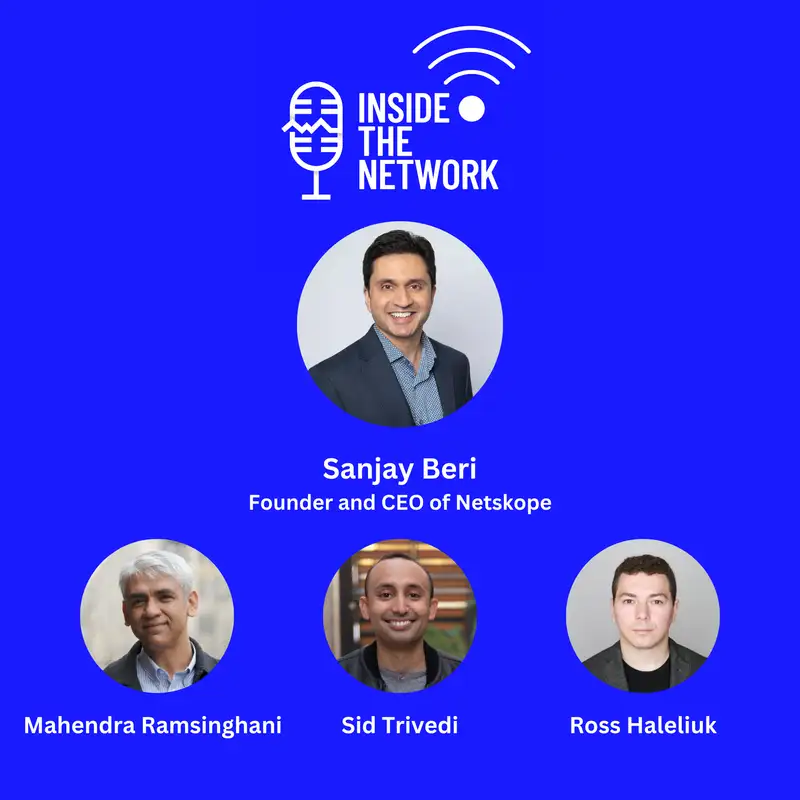
Sanjay Beri: Playing the long game and building Netskope into a public cybersecurity powerhouse
Download MP3Welcome to Inside the Network. I'm Sid Trivedi.
Ross Haleliuk:I am Ross Haleliuk
Mahendra Ramsinghani:And I am Mahendra Ramsinghani. We have spent decades building, investing, and researching cybersecurity companies.
Sid Trivedi:On this podcast, we invite you to join us inside the network where we bring the best founders, operators, and investors building the future of cyber.
Ross Haleliuk:We will talk about the hard parts of the founder journey, launching companies, getting to product market fit, raising capital, and scaling to an exit.
Mahendra Ramsinghani:And, yes, we will also be talking about epic failures.
Sid Trivedi:But, Mahendra, we're here to make the founder journey easier.
Mahendra Ramsinghani:That is correct, Sid. But we cannot make it too much easier because startups are hard, and, of course, you already knew that.
Ross Haleliuk:Alright, you two. Enough. Let's get started with this week's episode.
Mahendra Ramsinghani:Today, we are thrilled to have Sanjay Beri, cofounder and CEO of Netskope. Having started Netskope over thirteen years ago, this cybersecurity company sits at the epicenter of three important vectors, AI, data, and global edge networking. It serves over 4,000 customers, including 30% of the Fortune 100, has a team of over 3,000 employees spread across 30 countries. To build this giant, Sanjay raised over $1,400,000,000 across multiple rounds and then took Netskope public in one of the year's standout IPOs. What makes Sanjay such a compelling CEO?
Mahendra Ramsinghani:What are some hard earned lessons and inspirations that founders can draw from his thirteen year journey? And most importantly, where does Netskope go next? Let us dive in.
Sid Trivedi:Sanjay, welcome to Inside the Network.
Sanjay Beri:Thanks for having me.
Sid Trivedi:We're gonna talk about a whole bunch of different things, but let's start with your early years and the pre Netskope journey. In those early years, you grew up in Canada, and there were some moments in your life that likely shaped your thinking as an entrepreneur. Could you talk a little bit about some of those moments? What were those things that that really shaped how you kind of build today?
Sanjay Beri:That's a great question. I I think one of the core things as an entrepreneur is, like, what kind of culture you wanna live your life in and what kind of culture you want your company, to have that feeds, you know, the team that you attract and everything. And so I grew up, selling door to door with my mom, lipsticks and, and so on, and that taught me the phrase I live by grit, which is just guts and, you know, tenacity and so on. And so and that's what you need as an entrepreneur because you get punched in the face a 100 times. And so, anyways, I think that summarizes maybe twenty five years because I'm gonna keep it brief.
Sanjay Beri:But from there, it was, you know, figuring out what do I wanna do. Like, you know, you gotta pick a domain. I love to build. I love to have grit. I wanna work with the right people.
Sanjay Beri:Eventually, that led me to a domain, which was security and networking. And that's where I spent my career, creating problems first, and now for the past twenty years, trying to fix them. And so that's the Reader's Digest, as we say in Canada.
Sid Trivedi:And talk a you you mentioned kind of how you ended up picking security. But before you got into cyber, you kind of came out of college. You joined Microsoft. You're working on hypertext display within the browser team in the mid nineteen nineties just as the first Internet wave was getting started. Then after that, you worked on ASIC design.
Sid Trivedi:You worked on firmware design. You started a little bit with software security. How did you end up in in cyber? Like, that's not an obvious kind of path towards cyber.
Sanjay Beri:It's funny. ASIC design is hot now. That's for sure. So I think, like, the pragmatic reality. I did my master's in a right electrical, and I did ASIC engineering.
Sanjay Beri:And after I finished, I went, oh my god. These people are smart. I'm not so sure I'm gonna cut it here as a engineer. And it really for me, I'd seen software. I'd seen firmware.
Sanjay Beri:I'd seen hardware, and I found my love at the intersection of, really, business and some of the largest technological trends. And that led me to software because that's where you could get pace. That's where you can make an impact. And for me, I remember building a chip when I was in university two years, came back, plugged it into an oscilloscope, got a bunch of waves, and I went, okay. I need more than that.
Sanjay Beri:So that led me to, really software in the industry and and beyond. But they're all connected, so it gives me a good feel of the whole stack.
Ross Haleliuk:Talk to us about the trigger to start your first company, Ingrain Networks. I think at the time, you were pretty young, probably 26 or 27. And we know that at that company, you did everything from architecting the products to being the top salesperson and did pretty well because in less than four years, the company got acquired by SafeNet. Walk us through these four years. Walk us through some of the key inflection points and the lessons you learned on that journey.
Sanjay Beri:Yeah. First of I was I won't give you my head, but I was much younger than that. So I have to admit. And, look, I'd worked throughout my school career. Even when I went to undergrad, I worked at a place where I could leave and go work.
Sanjay Beri:And and same thing when I went to my master's, and I did it to be very clear. Also, I needed the money to pay for my college and my university. And so, one, it was great. Great experience, and I love doing it, but it was also a necessity. And so, actually, that first company was started with a professor who I happened to just meet again yesterday in my office for four hours and out of Stanford.
Sanjay Beri:And he was actually my professor. I won't tell you what grade he gave me, by the way. And that's what led me to go, look. I I tech. I love security.
Sanjay Beri:I love building. This gives me product management, engineering, building a company, learning what not to do, and learning what to do. And and that's how I started. It was sort of this intersection of knowing this professor and loving building, and, also, I gotta pay for my next semester. So
Mahendra Ramsinghani:Now post ingrain, you joined a big company, Sanjay, the classical shift from an entrepreneurial journey to a large company. Most founders were dread doing that. Why did you decide to go down that path?
Sanjay Beri:Yeah. It's a good question. And and it's like I always say with all answers, it's no one answer or one person, and there's no right path to anything. And, I mean, there's the high integrity path, which you should always follow. But it's, you know, it's a different path in terms of the rest.
Sanjay Beri:And so for me, I wanted to broaden my exposure from a go to market perspective, from running something at scale. And so the intersection of building, driving from a go to market perspective, and building a channel, selling, running the product at the same point, that's really what it allowed me to see. How does that work in a large company that's global, that is not starting, but is more mid to late in their life? And so that's why I went there. It was that combination at that point of innovating and giving me exposure to the rest and and running a business unit with a p and l.
Sanjay Beri:That was a great way to do it.
Mahendra Ramsinghani:And so you were managing almost 300 people, p and l that was several $100,000,000. What was the the most frustrating part of being in a large company coming from a start up? And then what were some opportunities or advantages that came with it that allowed you to shape your next phase of the journey?
Sanjay Beri:Yeah. So, you know, when I was at Juniper, I would say, like, a lot of my business unit, which many of it now are separate companies because they got spun out or it was sort of everything. Like, if I remember Juniper time is routing, big router, service provider. So what I was doing was everything that was not core. So you know?
Sanjay Beri:And so you think about that. You gotta scrap, right, to get sales attention, to get SE attention, to get dollars, to get channel mindshare when they're trying to sell everything, to make sure that you can innovate, right, at a more rapid pace. So because you you it is even behooves you more. You gotta win based on how good your platform is. You're not gonna get as many shots.
Sanjay Beri:Right? And so it really taught me when you're an underdog, when you're have to be scrappy, when you don't have everything aligned perfectly for you, right, how do you win? And for me, that was a great experience while understanding and seeing all the rest.
Mahendra Ramsinghani:And just for context, Juniper was the underdog to Cisco, and that's the battle that you were fighting at the time.
Sanjay Beri:Yeah. Even more so. Like, they were the underdog Cisco on the routing side, but even within the company, remember, we were doing security. And and so we weren't even doing routing. We were doing, like, the at that time, things like the intrusion prevention systems, the NACs, the v the SL VPNs.
Sanjay Beri:Even within the company, those were the underdog products because they didn't get all the dollars. Right? And so it was also how do you operate within an environment where you kinda have to own it and drive it, and you kinda have to drive your own sales and your own SCs and your own x, and you don't get the benefit of the mothership.
Sid Trivedi:So, you know, you spent seven and a half years at Juniper. You became one of its youngest VPs at the time. And let's talk a little bit about the beginnings of Netskope. So it's 2012. You can see the world is changing.
Sid Trivedi:Cloud is starting to become an interesting topic of conversation. You could have easily built CASB at Juniper, or maybe you couldn't, and we should talk a little bit about that. But what were some of the non obvious reasons you chose to go back to being a founder again?
Sanjay Beri:Yeah. So a couple of reasons. One, I have always believed in the phrase innovate or die. And I've always believed in this culture of being open and collaborative, high integrity, so on. And I've always believed that sometimes in the industry, you gotta stand start from a blank whiteboard because porting and moving leads to solutions that aren't meant for the times.
Sanjay Beri:And so I left Juniper because I knew that, look, I wanted to do those things. Right? And and to do it, I gotta start with a blank whiteboard. I saw the massive trends of, obviously, cloud and mobile and work from anywhere, and this was a unique time where the entire architecture of enterprises and how they dealt with, how they secure that new world would change. And so one, opportunity.
Sanjay Beri:Man, inflection points galore. Two, look. This is what I was built for, all of that past experience of gritting and gutting things and building and driving product and go to market. I wanted to create my professional legacy, and so I left to do that. And then three, I knew that culture part was so important to me.
Sanjay Beri:And I often feel that large companies sometimes lose their way and from a culture perspective, and it's, you know, it's normal. It's the way it is. And I wanted to build my own culture where I felt that could be an advantage and also mimic the way that I wanna live my life. And so those were all reasons why I left. It wasn't one.
Sanjay Beri:I had to ask my family and my two year old at the time, but she didn't have a way to give me a response. But she gave me those eyes, and I'm like, okay. Looks good to me. So
Sid Trivedi:Did you did you leave Juniper not knowing what that you would build Netskope and CASB, or did you already have the idea and you knew that you were gonna go and do this?
Sanjay Beri:No. I left, and I took some time. Obviously, like, the core things, I knew what was happening in the world. I spent my life with CXOs. I like to even today, every day, two CXOs a day is my saying.
Sanjay Beri:And so I lived in the trenches, but I also had a view of what happens in the clouds, meaning in the industry. Right? I feel like you have to have both views. And so I I had a sense of what was happening, but I took some time to figure it out of what exactly that looked like. And what may surprise you, it wasn't to build a CASB.
Sanjay Beri:It my view was that over time, the Internet and users and nonhumans would need a new highway, a new on ramp, right, to the Internet. It would take all traffic. Doesn't matter what it was, web, cloud, SaaS, now AI on prem. How could I build that new secure on ramp? Now the reality of why I went after CASB, which many people may not know, is like, look.
Sanjay Beri:Imagine you walk into some large Fortune 100 and say, hey. By the way, I'm going to replace your core Symantec proxy, and I'm gonna consolidate seven things. And they ask you, who are you? And I said, I'm Netskope. And they say, Netscape or Netskope?
Sanjay Beri:What? So they don't know who you are. And so you have to build your brand. And the easiest way I felt like with this grander mission was, hey. Use the platform we're building.
Sanjay Beri:First, apply it to cloud because nobody had anything. And that was how CASB was born. But the grander vision was always there, and that's actually how we built in the grander vision in mind. And that's why I think we were successful as many of the other point players fell off was we never were trying to be.
Sid Trivedi:And, you know, on this topic of kind of you you decide to go and start Netskope, you had already had the experience of being a founder and CEO with Ingrain. You'd had the experience of being at a big, you know, hyperscaling company like Juniper. What were the things that you decided take from one and the other? What were the learnings where you said, hey. I'm gonna do x that I took from Ingrain, but I'm not gonna do y.
Sid Trivedi:And I'm gonna do x that I took from Juniper, but I'm not gonna do.
Sanjay Beri:Yeah. So, you know, actually, to be clear, I'd never been a CEO, actually. Actually. Like, at at Ingrid, I was running product, and in Juniper, I was a GM of a group. And so this was actually my first real, you know, CEO experience.
Sanjay Beri:And when I looked at it, the things I took away were this. Being a GM, you touch all parts of the business from finance to legal to go to market and sales and channel and distribution to product. And so and at scale, right, you see that. When you're building a company, whether it's like Ingrid, and you're just starting from nothing, you see the startup and the funding and the board experience and and all of the nuances of the good and bad from small to the very large. And one of the things that I take away from all of those is you learn as much as from what you or your team or people around you did right as you do from what, you know, they did wrong.
Sanjay Beri:And and I could go on for hours about what I learned, but one of the core things was people, team, talent, culture, nothing to do with tech, how that can build a company and make it or how it can destroy it. And it can destroy it a lot quicker if you make the wrong choice than you can make your company. And so I was very, very particular in building my company on who did I want in that company from a culture perspective, from a board perspective, from an investor perspective, and the expectation we set of going long and building this to last for a long, long time. And so all of those really set when I set started Netskope, set it on the right path.
Ross Haleliuk:This is a very, very good way to jump into the next question, which is talking about the people, talking about the who, talking about the people who build Right right from the very beginning, Netskope had some really, really strong engineering talent with very deep expertise in both networking and threat detection. Like, from Krishna to Labin, Ravi, Rahul, and and and and a number of others, what did it take to extract these key engineers from very well paying jobs at global companies to go and work at the start up?
Sanjay Beri:I think, like, for people, they're all at different stages of their lives, and they're all different people with different situations. And so it's not always the same. But I'll tell you, like, the core pieces. One is they they they want they have to have the fire. Right?
Sanjay Beri:They have to have the fire. They have to wanna know that, look. I wanna build. I know I'm gonna get punched in the face a 100 times. I gotta have the intestinal fortitude.
Sanjay Beri:And so for me, one, in the beginning, you gotta have those characteristics. Otherwise, you're not gonna go try to get those people. Right? Because they it's they're not gonna survive when you're building. The second is they have to with those care they have to believe.
Sanjay Beri:They have to truly believe in what you're building, the problem you're going after, and how you're doing it. Because there's no sense in getting a great person if they don't truly believe in the beginning on what you're doing, and that'll drive them. Right? That'll self motivate them. Three is culture.
Sanjay Beri:I will take a nine or 10 on culture and a seven on domain, right, every day of the week versus the opposite. And if they're not gonna be open and collaborative and not you know, if they're gonna promote bureaucracy and BS and politics, they're not gonna be here at NETSCO. And so for us, it was a right time in your life. You wanna do this. You got the fortitude.
Sanjay Beri:You fit the right culture bar. You believe in the mission. And then look. When you're building, who do you hire? You hire architects and engineers who can build.
Sanjay Beri:Right? And and good ones, right, and people who can be flexible. And and and so that's why. And I think those people, they saw the mission. They wanted to be part of a team with these people, with this culture, and that's why they came, and that's why they they stayed.
Ross Haleliuk:Having done it so well, Sanjay, what advice could you share with founders today who are focused on recruiting and building their very first engineering team and hiring those first key people?
Sanjay Beri:Yeah. So first, you said having done it so well, so I'm gonna correct you. Like, when you're when you're outside, everything looks up into the right, but when you're inside, you know, come on, like, you know, let's there's no nobody likes to market. It's like a jagged lineup. Right?
Sanjay Beri:You go through ups and downs, and you make mistakes, and you learn from them. And that's the life of building a company. Right? And so one, I think everybody should know that is normal. Like, don't think there's this beautiful arc.
Sanjay Beri:Okay. Maybe there is in some a fewer companies, but that's just the way it is. And so the advice I give you on on people is, and everyone makes this mistake, don't go for the names. Don't go for when you're picking and remember, when you pick people, you're picking your investors for one. In your investors, make sure those people believe in what you do.
Sanjay Beri:Right? You pick a firm, but more so you pick a partner. Make sure they believe in what you do. Make sure the partner has staying power in that firm. They have sway.
Sanjay Beri:Right? We all know that a bad board member can destroy your company. And so you've gotta pick people where you have set expectation on what you're doing. It's okay if they that's not the expectation they have. Then that's not who you want.
Sanjay Beri:Right? In my case, it was go long, fit this culture, and we're not trying to be a small fish in a small pond, and so look. This is you gotta go along with us. And so pick your board and your investors very carefully. Same thing with your people.
Sanjay Beri:I'm a believer. Don't pick the person who is a 10 on domain and six on culture. It'll destroy you. And so it may not may look good on paper, on a website initially, and you may feel good, but when it comes to actually executing, you won't. So, anyways, that's some short advice.
Sid Trivedi:Talking you it was interesting that you mentioned kind of culture, and you connected that to board and investors. Mhmm. Talk a little bit about, like, why is culture with board and investors important, and how how should a founder even assess this? I know Mahendra has written a book on startup boards, but I'm curious, like, your thought process and, you know, picking those board members. Like, how did you interview them?
Sid Trivedi:How did you decide, hey. This is somebody who's gonna work with how I see the world?
Sanjay Beri:Yeah. And so, look, everyone may not have this time, but I got to know the people that eventually became my board members well in advance of when I started my company. I got to know them in the industry. I would attend events, you know, with CXOs and with the events they were holding, and, and I wasn't even I was not even gonna start my company for a few years. Right?
Sanjay Beri:And so you wanna get to know people well in advance just like you wanna raise money when you don't need it. You wanna get to know the people way in advance, build a relationship. So for the way I would think about it is make sure that you are not trying to get a read on someone in one meeting or two meetings or one hour or one week or one month. Like, you just you can't. Right?
Sanjay Beri:And so longevity of the relationship and assessing it and then talking to a lot of people who work with them is key. And and, you know, it's nothing there's no rocket science, but it it really matters. And, look, people wanna be on boards with others who are, in my view, of the right culture. If they're open and collaborative, they'll attract other board members who will work well, and you have a highly functioning board. You're not gonna walk in and and, people are standing up.
Sanjay Beri:I would tell my board members, like, please don't come up to a board meeting. Stand up and pontificate and say, twenty years ago when I did this and I oh, wait. You mean when there was no Internet? So sorry. And and we would laugh about that, and and the fact that they could very much laugh on it meant that they, you know, were probably gonna filter in the right direction.
Sanjay Beri:So so we just want collaborators, open transparency. I text my people, like, WhatsApp WhatsApp them or signal them, or call them, and and that's the type of relationship I want, and and, I feel like a good board has that.
Mahendra Ramsinghani:You know, it's fascinating that you had the good fortune of building that relationship with both the team that works with you as well as the board and investors. I would imagine that was the foundation that allowed you to start building product quickly, start competing. I think Skyhigh was already maybe a few steps ahead of Netskope at the time. So tell us about the journey from going to, like, this concept to product to a million dollars of ARR.
Sanjay Beri:So one of the things that I mentioned before was go long. And what I meant by that is, for us, I had a grander vision in mind. Wasn't CASB. It wasn't. It was this kinda what we're sort of trending to now.
Sanjay Beri:And so without even our board and investors, I had to set expectation that, look. Here's the grand vision. The steps to revenue, if you you know, could be much shorter, right, if we didn't have that vision. And by self filtering so they understood that, setting expectations, it's it's a much easier conversation, right, when you come in and you start your second quarter of selling first. But in our case, we spent time to build, to build it right, to build some core platform.
Sanjay Beri:We got our product out probably a year, I would say a year and a half, year after even brought on the first people, and we hit our million, right, pretty much in that well, obviously, in the first year. And it was obviously because we were in the bull's eye of where the world was going, and for us, we did that by look. We were selling. Right? You know, founders sell, and and we did that, and it worked out well.
Sanjay Beri:And so it was, yeah, it was a great, you know, first year. I will tell you, though, that for many of our board members and many of our team members, because we were very clear that we're going long and building for the long term, there was no expectations that were different in terms how we were allocating our capital. We were not flooding the market with sales and marketing. We were pouring it into r and d. So
Mahendra Ramsinghani:And I would imagine that when you are in that phase, as you're setting expectations and playing the long game, it clearly reduces the pressure on the team, but that doesn't mean that the sense of urgency does not exist. Now for our audience who are founders trying to understand product market fit, trying to get the first few customers actually, Can you share what who was the first customer? How did that happen? And what was the the magic you used in attracting them? Obviously, you're not called Netscape.
Mahendra Ramsinghani:You're called Netskope. So what was the magic you used at the time?
Sanjay Beri:Yeah. The the magic, like, for attracting our first customers was a very targeted use case. And in this case, it was, you know, how do I secure cloud storage and, you know, SaaS. And not trying to boil the ocean. Even though from a platform and r and d perspective, we were building something broad, look, it was pragmatic and realistic enough to know that you can't you don't build in a vacuum.
Sanjay Beri:You get customers. You have them deploy. You solve very targeted use cases where you play well with the big players, right, even though you're gonna target the big players. And so we sat beside the Symantecs and Trellixes and Politos and others, and and we were complimentary at some level, even though we're gonna go after that space. And so I think for us, we knew the politics of companies.
Sanjay Beri:Do not step on other vendors of those type, the big ones, when you're starting. Pick off a targeted use case, greenfield, win that use case, show value, and then you can reveal the rest of your vision. Right? Because politics matters when you sell, and never underestimate how much of your company and your ARR and your revenue has nothing to do with product. So
Sid Trivedi:Let's talk a little bit about growth and scaling to that IPO. Every company has different phases of growth. We have early growth, which is the million to 10,000,000 of ARR. Then you have kind of mid stage, which is going from 10 to a 100,000,000 of ARR. And then you have real scale, which is a 100,000,000 to a billion and more of ARR.
Sid Trivedi:Give us an inside view in your role as CEO, how your thinking around growth changed at each of these three phases. What was the most important thing that you thought about from one to 10, from 10 to a 100, and then from a 100 to billion, which is obviously where you're focused today?
Sanjay Beri:So, you know, first of all, from a go to market perspective, it looks very different. And what I mean by that is even think of, like, your head of sales. Like, the reality is that when I hired my head of sales for the one to 10, I told this person when they were interviewing this sounds really bad, by the way. I understand. You may not be you're probably not gonna be my head of sales in two years.
Sanjay Beri:And he looked at me and said, that is the worst close I have ever heard. Are you trying to close me, or what are you doing? So and and I said, well, come on. And and he actually looked at me and went, okay. I understand.
Sanjay Beri:I actually get it. If I can show you, I can do that. Otherwise, I'll run, you know, a region. I get it. Right?
Sanjay Beri:And so I think, like, the reality is at different levels, you have a different level of operational scale, a different level of playbooks, a different level of just repeatability. Right? Not ad hocness. And building those processes and that scale, it keeping the agility and the innovation and the startup mentality, you have to find the balance. Whereas in the beginning, your whole focus is not on the process and the, you know, scale.
Sanjay Beri:Right? It's just you wanna earn the right to be able to scale and build a process. And so I think that involves many times different people, different leaders. I flipped some of my core functions along the way at each of those levels. The others still stayed.
Sanjay Beri:They just, you know, learned and got mentored and grew. The second is the the reality is that as you scale, and in our case, as we scaled, we went after large customers. And when you think about large customers, other things matter other than your product. Right? What matters are your references, your ability to meet certain could be legal or privacy regulations, could be things unrelated to that around your infrastructure, right, and how it's being tested.
Sanjay Beri:And so there's a lot of, like, what I'd call noninnovative stuff that has to happen when you hit a certain scale to win certain sets of customers. And so we knew that, and so we had to invest in that. And and so it was a long list, but it would say different scale sometimes requires different people. Different scale requires different set of processes and repeatability. But what doesn't change is your culture.
Sanjay Beri:Right? Innovate or die. Be open and collaborative. Try to stake bureaucracy out and and politics. Right?
Sanjay Beri:That needs to live. It's just harder sometimes to keep it.
Sid Trivedi:I you mentioned a little bit about kind of getting the right people at the right stage. I think for founders, typically, I spend time with them, founders when somebody's not working out, it's pretty obvious. You know? Oh, this person is not actually delivering. The hardest part actually is when somebody has actually tapped like, they have done a lot of work, a lot of amazing work for the company, but they have tapped out in terms of their capability.
Sid Trivedi:How did you figure out to identify that, oh, this person has been amazing for Netskope for the last three years Yeah. But I don't think they're gonna be amazing three years from now?
Sid Trivedi:Like, what are the attributes you look for? And then how do you figure out in your head that despite them being so loyal and so valuable that now I do need to upscale, and I do need to go and find the next great person?
Sanjay Beri:Yeah. And so there's a couple of things that are kinda sometimes you say nonnegotiable, like, you know, especially, you know, if you're a leader, which could be an individual contributor who's a technical leader. It could be, you know, an actual leader for region sales. Like, you do have to have the fire. And if you don't wake up having the fire, then it's probably time, right, to talk, about moving on.
Sanjay Beri:We've had definitely those, right, over the years. Some have retired. So so one is the fire. You gotta have it. Right?
Sanjay Beri:The second is, ultimately, are you going to be still a growth type of mindset person? Right? And if you get to the point where you're like, look. I know how this works. This is how I do it, and I can't do it another way.
Sanjay Beri:Then in the world we live in, that doesn't work. Right? I mean, the world changes so quick. It's so volatile. It's so, like, if you can't be self aware enough to know that, look, you should always be learning, and you should always be looking at changing how you do things, then also that's you've reached a point maybe that you gotta tap out, right, because you're you're just not as malleable.
Sanjay Beri:And then the third, you know, especially on the technical side, is and think about today's world, right, with people leveraging Cloud Code and Cursor and so, like, you gotta you have to be able to invest your time to understand the latest trends, capabilities, and so on. Could be technical, will be sales, could be SDRs, could be whatever. And and if you're not, you're actually going to decay. You may have been great when you started, but the world moved on and you didn't. Right?
Sanjay Beri:And so in a similar way, those folks will also quickly realize too that, wait a minute. Maybe in this time, I'm not actually the right person. And so, anyways, I like to have those open conversations. We have them, and that's why a lot of our transitions, you know, have been just been great. They've been good, amicable.
Sid Trivedi:Yep. In in September 2025, you formally listed Netskope on the Nasdaq. A huge congratulations to you and the team. And for our listeners, for context, there are only two cyber IPOs in 2025. There's SailPoint and there's Netskope.
Sid Trivedi:And there are only 11 tech IPOs, so it was a pretty audacious goal to make that decision to go public. You talked a little bit about your competitors. I'm sure there were multiple options to exit along the journey, including, I'm sure, even, you know, closer to the, you know, that IPO stage. How did you did you always know that you wanted to take the company public, and when did it become clear that the IPO was the right path?
Sanjay Beri:Yeah. You know, I I I preface this. There's no, like, right path that I would advise for any entrepreneur. Like, selling your company, totally fine. You know, doing something out, totally fine.
Sanjay Beri:For me, since the beginning, I've always said this is gonna be an independent company. It's always gonna be an ad scope, and going public is kinda gonna be our first inning. First inning took a little longer, by the way. So then I thought, yes,
Sid Trivedi:you know, because of the markets and the pandemic and all this stuff,
Sanjay Beri:you got, like, every year something thrown at you. Right? And so, anyways but so it was always my dream and vision to do this. But I also viewed and this may sound like people are really? But, yeah, I also viewed going public as as just the first inning.
Sanjay Beri:And and I know we're just on audio. We look around, you see a sports fan. And I felt like for us, we needed the aware we going public gives us the awareness. It it boosts who we are, gets us out there because, you know, we know that we can win if people know about us. And it also brings a lot of other things that maybe you don't wanna have to deal with.
Sanjay Beri:But for me, that was our goal. Get there, make that the first inning, and then, you know, go on from there. We have a saying, build an iconic legendary company, and, and that has always been the goal. And so going public would be one signpost on the way.
Ross Haleliuk:Let's talk about, making bets, making big bets, in a different area, in the area of technology. You've always believed that public cloud is not optimized for routing efficiency, and you decided to build an edge cloud. Now Netskope has, I believe, over 120 data centers in in 75 regions worldwide. Building all this out might not have been an easy decision. Why did you choose not to partner with existing players?
Ross Haleliuk:Why did you decide to go through all of this pain and then build your own infrastructure?
Sanjay Beri:Yes. Because I like pain. No. Just joking. Sorry.
Sanjay Beri:No. The reality is that I'm I have this philosophy. I always say go long, and I've always kinda believed it. And and some you know, it may involve sometimes going long involves much more pain in the beginning and the mid. Right?
Sanjay Beri:But if you go long and you have the fortitude to do it, you'll end up with something better, and you'll end up with a better outcome. And so building the our own network. We looked down. We said, look. The right thing to do from what people care about, performance, resilience, right, openness, and now sovereignty, is to have your own infrastructure.
Sanjay Beri:The public cloud is amazing for apps and for workloads and for but not as a network. Right? As a network, the performance their whole goal is it's like a casino. They wanna get you into, you know, the casino and then hide all the exits. That's kind of the goal.
Sanjay Beri:And the reality is in what we do, people access, you know, billions of websites. They have many public clouds. They access tens or hundreds of generative AI apps, thousands of SaaS apps. They're they're not trying to get to one place. We have to get them everywhere.
Sanjay Beri:And so it was very clear, and I hired the person who built and ran AWS's network. So even them, they're like, yeah. You're right. Like, this is what you need to do. Yet the issue, if you were a founder or a startup was, well, wait a minute.
Sanjay Beri:If you're gonna do that, that's gonna cost hundreds and hundreds of millions of dollars. You're gonna have to find and recruit across the world some of the best network architects, infrastructure people. I mean, it's gonna cost a lot of money. And but I had picked a board who I said was I told them, go along. I will admit that when I had this conversation with them, by the way, I'm gonna go spend hundreds of millions of dollars and do this, and and you'll see it in five years.
Sanjay Beri:There was a little bit of, Sanjay, what are you doing? But we knew it was the right outcome, the right thing, and it has paid off in spades for us. Now did it pay off in the first year or the second year or the third? No. Right?
Sanjay Beri:But it has paid off in spades, and I really am thankful with both our investors and our board and the people, the 100 plus people in the beginning on the infrastructure side we brought on. These people, they're they're artists. Right? That's that's the way I view some of these network folks and our investors believing and listening to kinda what I said in the beginning. That's what made it possible.
Sid Trivedi:How do you go in and position this massive investment to a board? What's the the the pathway that you go about doing this when you're you know, one is kind of convincing people to invest in the company. The second is trying to tell your board who are already investors that, hey. This is a good good strategy.
Sanjay Beri:So, you know, first of all, you're right. Like, having a financial model, which is a multiyear model, and I'm not talking about the model that is, you know, some marketing model. I'm talking about, like, a real model, is important to show, a, what does this look like? We have the fort fortitude, and we have the plan, and we understand what this is gonna do both from a top line perspective, from bottom line, from a gross margin, everything. Right?
Sanjay Beri:You've thought this through. Second, you understand how to do this, in the right way so that in the end, it actually proves to be both a product advantage and a cost structure advantage, which is compelling. Those are pieces, but you can show that. But all investors see spreadsheets and models all the time and, you know, I don't know. They probably look at them and go, okay.
Sanjay Beri:Thanks. You know, whatever. Anybody can put numbers in a spreadsheet. Showing them why it's the right way to do it. Why is this, in the end, going to lead to a big moat, right, one that is so difficult for anybody ever to cross.
Sanjay Beri:Right? That is what matters, and that was something we were very clearly able to do and show to validate with third party, you know, sort of people who eventually you know, I brought into the company and became part of the company. And in their heart, those people, they believed in it. They're like, you know what? This is the right thing to do.
Sanjay Beri:You told me we're gonna go along, and this is gonna lead to a better outcome. Now you better execute. So so and it comes down if it can come down to you just better execute in something like that, then that's great because that means they get it. So
Mahendra Ramsinghani:Sanjay, when when Netskope started, you know, Skyhigh was probably one of your primary competitors. You know, the world has changed quite a bit today. You know, I was looking at the twenty twenty five Gartner Magic Quadrants, and, you know, Netskope is very well placed in the top right corner, you know, with a few others, Palo Alto, Cato, Fortinet. Talk to us about how you see the world evolving, especially when it comes to competition.
Sanjay Beri:So I think if you look at the world in which we play security networking, I've never believed that there is one platform for all of security networking. I don't believe there's a 100 either. And when I work with a CIO or CSO or CTO, you know, they don't believe there's one either. That's not what they want. They don't want the best of nothing.
Sanjay Beri:Yet they don't want a 100. So first, my theoretical view has always been and my pragmatic view on the ground is there's a few couple core platforms and, you know, EDR and Identity and SASE and so on. There's a few. And so one, we're not trying to be everything. We're not trying to be all four of them.
Sanjay Beri:We're trying to be this massive core platform that converges 20 things. If you start there and then you look at the competitive market, you quickly understand, oh, okay. Well, that one is not really competitive. You bifurcate it. And then you end up with this cent this set of people who are either trying to be everything.
Sanjay Beri:Right? And you could put Palo Alto in that realm. And then there's the others who maybe are a niche out of a 100. And then there's the others like us who are none of them. We believe in a couple core platforms.
Sanjay Beri:Right? Not a 100, but not one. And so for us, there'll always be a Venn diagram of intersection where there'll be like many of the niche companies, which, you know, we do all that functionality. And then with the one or two trying to do everything, there'll be overlap. Right?
Sanjay Beri:And so that's kind of the way I look at it. And so competitively for us, look, we have an over 80% win rate if we get to POC. And so our nirvana is that they try what we do. We will consolidate 20 things, converge, but we'll play well in the ecosystem. And and I'm a big believer that we have a common enemy in security, and it's not any of our competitors.
Sanjay Beri:It's nation states. It's criminals. It's malicious insiders. And so play well.
Mahendra Ramsinghani:And so, Sanjay, you know, it's this notion of competition is important to build your muscle, you know, early on. You had Sky High that built your muscle. Which are some of the competitors that you look up to or, companies that you respect that are out there that are doing, good things?
Sanjay Beri:So I'll I'll take it from multiple angles. One, nothing to do with our domain. But if you think about organized companies who have been built and they went long and they adjusted and they kept going and they and they eventually became successful, the quintessential one of that would probably be NVIDIA where you go, my god. That was a long journey where they they had so many punched in the face moments and they became what they do. You gotta respect that for a founder who who just kept going and stayed with it and did what they did.
Sanjay Beri:So that kinda culture and that kinda intestinal fortitude, I really look up to that and respect that quite a bit. In addition to that, you look at other large companies who have navigated and adjusted and, you know, maybe went down and then went up, and you you gotta admire people like CEOs like Sachin Dell and others who really just who did that. Right? And and so, yeah, those type of people with that fortitude, those are the ones I look up to versus, like, companies to be blunt. I look at, okay, what kind of people, what kind of culture, and who are the the warriors who know reality is not easy, yet, you know, you power through it.
Sanjay Beri:And so those are two that I really look up to.
Sid Trivedi:As we get towards the end of this conversation, I wanna talk a little bit more about 2026 and beyond. Obviously, you're a public company now. You have a whole bunch of opportunities and challenges. And one of those, obviously, is is dealing with public market investors and having, you know, quarterly earnings calls and talking to equity research analysts, as well as thinking about business growth and strategy and how do you scale this business to well over a billion of ARR because that is something that every investor will care about in the public markets. Mhmm.
Sid Trivedi:What's top of mind in in, you know, in your head? How has that thinking changed going from private to public?
Sanjay Beri:Yeah. It's another good question. So a couple things. One, your time changes because as you know, you have this additive time that you need to do, which is spend time with your invest you know, public market investors. In the first year, education.
Sanjay Beri:Right? You're almost like a baby even though you're like, wait a minute. I'm a baby again? I thought I I got past the startup phase. Well, as a public company, you're you're a new company, and so you gotta spend time to educate.
Sanjay Beri:They you also have certain periods where you
Sid Trivedi:can do
Sanjay Beri:that. You really are, in many cases, competing against people who've had the ear of these folks for could be a decade, and you haven't even talked to them. Right? And so they heard your story from others, not from you. And so one is the time you have to spend with those folks to make sure you educate them.
Sanjay Beri:Those could be analysts. Could be investors. Eventually, you go to the conferences. And just make sure your vision, your story, your concept to go along is out there, and you're almost doing that again. So that's one.
Sanjay Beri:The second is the reality is that when you're public, you can lose your culture and what got you here, right, very quickly. And I've been very clear that I don't look at and manage my company, you know, quarter by quarter in terms of how I think about what we're building. It could be on the go to market side or it could be in r and d. We still go long. Right?
Sanjay Beri:We invest in things that may not ship for two, three years. We we're and we're not shy about that. Right? And that's because, look, I'm gonna be here in a decade doing this, and we wanna capture our TAM. And so don't let that change you and and change what got you here.
Sanjay Beri:Obviously, financial profile to go public now is very different. Like, when we went public, it's it was very it that was a much harder time when we went public than it would have been a few years ago. Right? And so, obviously, our we focused on our financial profile as well, and we know how important that is. But you can do both.
Sanjay Beri:Right? You can get that right and go long and innovate or die. So, anyways, the biggest thing I focus on, innovate or die, persist everywhere in private or public markets. So
Ross Haleliuk:Sanjay, you launched your AI labs, about seven years ago, well before the current wave of of GenAI. Today, you have over 150 models. Talk to us about the story. What got it started? How does Netskope plan to enable customers to benefit from this?
Sanjay Beri:Yeah. So the AI Labs was another go long story because, you know, we've had AI Labs for over seven years, and I have to admit nobody cared for five, externally, at least. Nobody seemed that I'd show up saying, here's this AI lab. They're like, yeah. Okay.
Sanjay Beri:Go to the next topic. But but the reason that we did that was once again, we felt like the best tool to solve the problems we were solving, data protection, threat protection, detecting anomalous network behaviors, and accelerating traffic. In many cases, deep learning, not LLMs only, was the right way. And so it was more about the reality and pragmatism of, look. Whatever people call it and whether it's famous or not, if it's the right thing, we're gonna do it.
Sanjay Beri:And so that's how our AI labs got built, and that's how we started building these models. And then when the market, it it said, oh, they wanted to talk about AI came out. Wait a minute. We are sitting on you know, it's what we've been doing, a 160 models. And so how do we use AI everywhere in our product?
Sanjay Beri:Deep learning, you know, statistical modeling, shallow learning, and, obviously, generative AI, we use it if it's throughout the products because it gives us better efficacy, better performance, and so on. Right? And they're just baked in. You don't buy the models. The second is we secure people's AI usage.
Sanjay Beri:Our whole goal is let people use generative AI, but put the guardrails in so they protect their data and their threats. And so it's really two sided. We use it every everywhere because where it's the best tool, we'll use it. And then on the opposite side, our whole platform, one of the big use cases is geared to let others use it in a secure way and protect their data. So those are two big use cases of how we really intersect at our core with AI.
Sid Trivedi:And just on that topic of of AI, I'm I'm sure you're seeing a whole bunch of new generation of startups that are being created. Many of them are really trying to go and help enterprises manage agents and the access that those agents have to data. In some ways, this is kind of ancillary to the CASB market that you started off with at at Netskope. How do you think about, you know, going after that that vision, and how do you think about broadly agentic identity? Because that's becoming more and more of a core topic.
Sanjay Beri:Yeah. Absolutely. So when you look at AI in general and agents and beyond, like I said, how we broke it up, like, there's identity and there's your in path governance so you can have policy. There's your monitoring and SecOps. So each of these markets, right, which traditionally have formed the core of security networking, right, have to change and are changing because of AI, how they implement, but also, you know, what they have to deal with.
Sanjay Beri:And I've always believed that just like, you know, when IoT and OT came up, there was so much more nonhuman identities because of that. In the agent world, I've always believed that, look, there's gonna be 10 plus agents per user, and most of your traffic will be originated from nonhuman identities. And yet, what are those nonhuman identities? They assume the user's permissions. Right?
Sanjay Beri:Or how do you attribute them? How do you know? And so a lot of this comes down to what we often phrase in the term as zero trust, Meaning, we have to assume that AI agents that are corporate, noncorporate, malicious, they just live within your company. And how do you find them? How do you discover them?
Sanjay Beri:How do you guardrail them? And yet, how do you let the valid ones do what they're supposed to do? So how do you solve this problem by letting people still unleash the usage of these? Right? And and that's the core of the security problem.
Sanjay Beri:It's not to block things. It's to enable them. And so without getting into all the details of how it changes identity or inline governance or data protection or so on, I think, like, our goal is enable it. Our goal is weed out what shouldn't be there, zero trust it, and we've had a lot of announcements related to it and a lot more coming.
Mahendra Ramsinghani:You know, Sanjay, as we were doing some of the research around this episode, we talked to people like Krishna and Ravi. And Krishna, in particular, helped me to appreciate your vision. And he sort of, said, from day one, Sanjay talked about the importance of, networking. The second circle of the Venn diagram is data, and then the third circle of the Venn diagram is cybersecurity. And so when we think about Netskope today, you set that foundation up so very well.
Mahendra Ramsinghani:The fact that AI Labs started seven years ago, five of which were not relevant, but then suddenly it becomes very relevant, sets Netskope for a a fantastic, we'd call it, second innings ahead. I took thirteen years from startup to IPO. You have over 4,000 customers, 2,500 people, 30 countries. And, of course, your daily diet of two CIOs and two CSOs. Tell us, as we close, what has been the most fun part of the journey and also the toughest?
Mahendra Ramsinghani:Or maybe you can start with the toughest first so we end on a positive note.
Sanjay Beri:Yeah. The toughest one. We don't have ten hours. So Yeah. Look.
Sanjay Beri:The toughest part is really that when you're leading a company in many cases that you get punched in the face every day. Like, you could wake up and something could go wrong. A person you were trying to recruit, a deal you're trying to win, a project that you were I mean, it's endless. Right? And I think, like, the toughest part to realize is that in addition to what you do at work, all these founders probably listen to this, they have a family.
Sanjay Beri:They have a life that is outside. And making sure that your energy will come from ultimately also that. And so making sure your team and making sure yourself get the time, devote that to their family, bring their family along as much as we can as part of the company, that's often the toughest balance, but it is the thing you have to do. And you and you can't keep it in the back of your mind because, ultimately, you have your professional legacy. But what matters is your life, right, and your life legacy, and that's what matters to people.
Sanjay Beri:And so I feel like, you know, making sure sometimes what may seem like the wrong decision to move the company forward, but may in the short term, maybe the right one long term, right, which is do what's right, right, by family and people and so on. So that's one, and I'm pretty adamant with that. And then you asked some of the greatest moments. The greatest moments for me, I'll give you an example. When we went IPO, we brought every single person in the company into the IPO.
Sanjay Beri:They told me I could bring 20. I brought a 100 plus to the IPO. Wow. They said I could have 10 on the stage. I brought every single person on stage I could.
Sanjay Beri:We brought every single team member livestreamed in, whether it was an office, at home. I had people in Medellin in Colombia who who would never ever experience something like that, where they're able to get their face, you know, on that board. They walk around their town, and they show, look. Look at what I've done in my life. And I think, like, the most proudest moment I have is we know we will change the lives of so, so many people and generations of their families.
Sanjay Beri:And that, in the end, when you put your head in a pillow, in addition to obviously what we do, which is protect people from the worst people in the world, which is attackers and criminals, that's what we build our platform for. In addition to that, you you are changing lives of a lot of people in your team, and that'll live forever, it's probably your biggest legacy you have. So
Mahendra Ramsinghani:How cool is that? The Medellin Columbia story is such a fantastic way to share all the joys and the excitement of this journey. Sanjay, thank you so much for joining us today.
Sid Trivedi:Thank you for joining us Inside the Network.
Ross Haleliuk:If you like this episode, please leave us a review and share it with others.
Mahendra Ramsinghani:If you really, really liked it and you have some feedback for us, wrap it on a bottle of Yamazaki and send it to me first.
Sid Trivedi:No. Don't do that. Mahindra gets too many GIFs already. Please reach out by email or LinkedIn.